
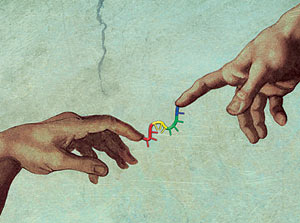
 The Economist’s feature on RNA and what it means to genomics includes a broader observation about the our place at the cusp of a profound revolution in biology:
There is in biology at the moment a sense of barely contained
expectations reminiscent of the physical sciences at the beginning of
the 20th century. It is a feeling of advancing into the unknown, and
that where this advance will lead is both exciting and mysterious.
I certainly share this view. Sitting atop a bioinformatics project for a couple of years it became obvious to me that the convergence of software development, computational power, and wet lab experimentation is moving us to a transformational moment, a reaching of escape velocity, in life sciences. Whether the analogy is physics in the 30’s or IT in the 80’s, something exciting is about to happen.
In addition to the suggestion that:
If RNA is controlling the complexity of
the whole organism, that suggests the operating system of each cell is
not only running the cell in question, but is linking up with those of
the other cells when a creature is developing. To push the analogy,
organs such as the brain are the result of a biological internet. If
that is right, the search for the essence of humanity has been looking
in the wrong genetic direction.
My prediction is that we will find that RNA is networking beyond the bounds of individual organisms, and we humans will understand how the human genome is only one of our many genetic masters.
 iBiome
Interesting, what do you think about Prions [ http://en.wikipedia.org/wiki/Prion ]? Can they be information carrying vehicle? But in essence both are coded from DNA (even the RNA viruses carry reverse transcriptase to go back to DNA).
How about the MEME [ http://en.wikipedia.org/wiki/Meme ] theory of Prof. Dawkins?
LikeLike
Prions – I don’t know very much about them and I have to confess I’ve not thought of in those terms, but why not?
I’ve read Dawkins meme theory and I am not convinced they are a unit of selection – yet. I guess the problem for me is that a meme, at least as described in the Selfish Gene, lacked a rigorous enough definition.
LikeLike