
Guelph opens first centre for DNA barcoding

Img_6775

Links: CTV.ca and The Barcode of Life

A Canadian institute working to compile a database of DNA barcodes for every species on earth officially opened on Wednesday.
The $4.2 million The Biodiversity Institute of Ontario, at Guelph University, is the fist of its kind in the world.
The barcode technology identifies species by analyzing short regions of their DNA instead of the whole genome.
"We are the world’s first barcode factory," said Dr. Paul Hebert, director of the institute and the first scientist to propose DNA barcoding.
This process, which uses a short DNA sequence on a common gene to differentiate between multi-cellular living things, makes it possible to identify species much quicker than before.
The barcoding technique has already led to the discovery of new bird, butterfly and fish species.
"Less than one-millionth of all the DNA is enough for us to tell what species an organism belongs to," Hebert explained.
With old technology, the institute would have been able to identify about 1,000 species a year.
Once the institute is completely up and running, it could categorize up to 500,000 samples annually.
Hebert said that this technique could allow scientists to identify an estimated 10 million species in the next 20 years. Only 1.2 million have been formally categorized in the past 250 years.
Once a species is identified, its barcode is uploaded to Barcode of Life Data Systems, an online database, where it can be accessed by other scientists.
Researchers can enter a DNA barcode on the site. If there’s match, the database can provide the corresponding species.
The institute has already described almost 28,000 species with barcodes, and they’re getting tissue samples from around the world sent to them for quick analysis.
Hebert said he’d ultimately like to see DNA barcoding put to practical use for things like pest management, food safety and environmental monitoring.

Science you can use

Retrospectacle: A Neuroscience Blog highlights a new study linking oral sex to throat cancer.  Apparently a strain of HPV contracted orally increased the risk of contracting a form of throat cancer 32-fold.  Another reason to support the HPV vaccine.

Furthermore, drinking and smoking did not exacerbate the risk of
throat cancer in these patients—it was really *just* the virus.
Despite this increased risk, the overall risk even for people who
carried HPV, was very low. Its also important to note that the number
of patients in the study was low (100 cancer patients, 200 normal
controls) so the results should be replicated before you
make…er….adjustments in your lifestyle.

It would extremely interesting to determine if the HPV vaccine can
also protect against oropharyngeal cancer as well as cervical cancer.
Hopefully, this lab or another is working on detmining [sic] that.

Interesting side note: the authors also pointed out that, "Poor
dentition, infrequent toothbrushing,and infrequent dental visits have
been associated with an increased risk of squamous-cell carcinomas of
the head and neck." Wow! Not brushing your teeth increases your risk of
cancer?! I’m going to brush them right now!

You’ve been warned.

DNA variant puts Caucasians at higher risk for heart disease

What’s interesting to me about this find is the linkage, as described below, between this region of the genome and 2 major disease groups.  Pure speculation but this region perhaps is linked to a nutritional function that was beneficial in times of scarcity and lethal now in a world of plenty, as both CVD and diabetes are associated with food abuse.   Link: globeandmail.com:

Two massive and independent studies have discovered a significant
new risk factor for heart disease — a menacing hunk of DNA that half of
all Caucasians carry.

Researchers found the heart risk linked to this genetic trait held
up regardless of whether other well-known signs of susceptibility, such
as high blood pressure, smoking or high cholesterol, are present.

As a result, the finding raises the prospect of a genetic test to
help identify people at high risk of heart disease and measures to
prevent it. It could also lead to a better understanding of the biology
behind the world’s No. 1 killer, since no one yet knows how this
genomic quirk works….

Based on research involving 23,000 people in Canada, the United
States and Denmark, scientists found that 50 per cent of Caucasians
carried one copy of an altered stretch of chromosome 9, and as a
result, their risk of developing heart disease rose by 15 to 20 per
cent. A quarter of Caucasians carried two copies and faced an increased
risk of as much as 40 per cent….

…Meanwhile, in a coincidence that has even top geneticists surprised
at the odds, three different groups reported last week that this same
region of chromosome 9 could also raise the risk of Type 2 diabetes.

Francis Collins, director of the U.S. National Human Genome Research
Institute and one of the diabetes investigators, said: "I think this is
a stunner. This is like the seat of the soul of the genome. It seems
like this one place carries all of that weight for two very common and
very dangerous diseases.

"I never would have guessed that we would end up coalescing, zeroing
in on the same 50,000 base pairs out of three billion [chemical units
that make up DNA]…"

a rare and expensive tome

Capturedata78

A colleague and I were searching for a copy of Evolution by Gene Duplication by Susumu Ohno, in part to insert some knowledge on the subject into my thick head, and Sweet Fancy Moses! it’s expensive. More than 2 Gs for a copy in good condition.  Given that it’s still the text on the subject I was shocked at how hard it is to come by.  Not even any e-versions I could find on Google.

There are copies (currently out) in the SFU and UBC libraries.  Any other options?

Shameful

Infant mortality in Mississippi has risen to 11.4 / 1000, up from 9.7 the previous year, worse than  places like Costa Rica  (9.4), Ukraine (9.5), and Bosnia (9.6). Inexcusable in a wealthy, modern, country.  Rates are similarly far too high in the Canadian territories of Nunavut (16) and Yukon (11).

Link: Infant Mortality Rising in Deep South in US.:


In Mississippi itself, infant deaths among blacks rose to 17 per
thousand births in 2005 from 14.2 per thousand in 2004, while those
among whites rose to 6.6 per thousand from 6.1.

The overall jump in Mississippi meant that 65 more babies died in 2005 than in the previous year, for a total of 481. …..

….
The main causes of infant
death in poor Southern regions included premature and low-weight
births; Sudden Infant Death Syndrome, which is linked to parental
smoking and unsafe sleeping positions as well as unknown causes and congenital defects….


…Poverty has climbed in Mississippi in recent years, and things are
tougher in other ways for poor women, with cuts in cash welfare and
changes in the medical safety net.

Dr. William Langston, an obstetrician at the Mississippi Department of Health, said the state was working to extend prenatal care
and was experimenting with new outreach programs. But, he added,
"programs take money, and Mississippi is the poorest state in the
nation." …

…Oleta Fitzgerald, southern regional director for the Children’s Defense
Fund, said: "When you see drops in the welfare rolls, when you see
drops in Medicaid and children’s insurance, you see a recipe for disaster. Somebody’s not eating, somebody’s not going to the doctor and unborn children suffer."

In 2004, Governor Haley Barbour came to office promising not to raise
taxes and to cut Medicaid. Face-to-face meetings were required for
annual re-enrollment in Medicaid and CHIP, the children’s health insurance program; locations and hours for enrollment changed, and documentation requirements became more stringent.

As a result, the number of non-elderly people, mainly children, covered
by the Medicaid and CHIP programs declined by 54,000 in the 2005 and
2006 fiscal years.

Colony Collapse Disorder

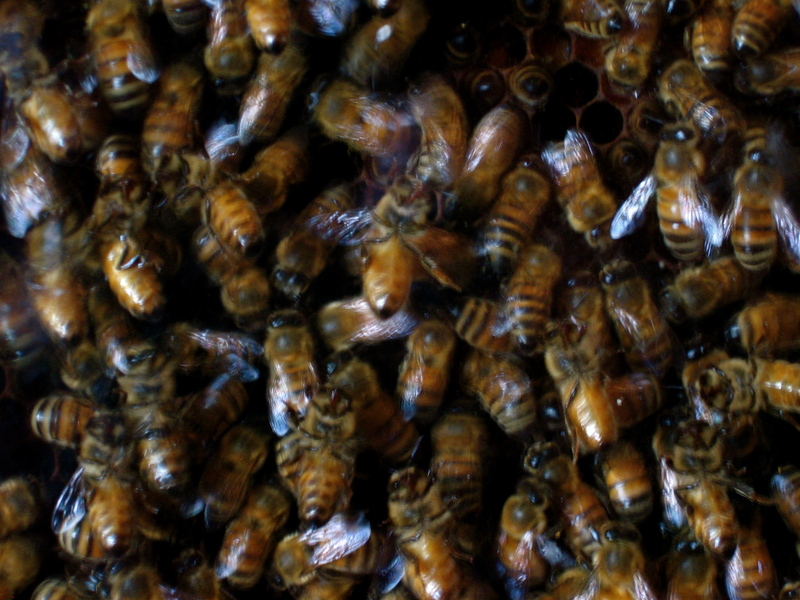
One of the great triumphs of civilization, (and one that may just help put an end to us) is that most of us in the developed, urban world can afford to ignore the barely visible cloud of ecosystem functions and services that we float comfortably on.  Barely Bees
conscious of the fragility of some of these essential systems, we are slow to grasp the importance of what one might consider "the little things".  Listening to Bill Maher’s Real Time last night I first heard of Colony Collapse Disorder and the apparent loss of 50% (!) of honeybee hives in North America and Europe.  This made the news as it was speculated that cell phones are a contributing factor. 

Grrrlscientist (Pathogens Causing HoneyBee Deaths?) notes another take on the phenomenon i.e. that it may be caused by a pathogen.  Regardless of the cause, the loss of substantial numbers of a key pollinating insect could have absolutely enormous consequences for our food supply.  This is spooky:

During the previous year, bee keepers and other experts have observed
tremendous declines in honeybee populations — often entire colonies
disappear suddenly and without warning, a situation referred to as
"collapse" so scientists refer this phenomenon as "Colony Collapse
Disorder" or CCD. Thus far, approximately 50 percent of bee hives have
collapsed in this manner. As a result, experts fear that this loss of
honeybees will have an enormous horticultural and economic impact
around the world, leaving important food crops such as fruits,
vegetables, and almonds unpollinated, so they are working hard to find
the cause of this mysterious syndrome, and this cutting-edge technology
might have provided them with an answer.

Newmont cleared in Indonesian pollution case

Link: CNN.com.:

MANADO, Indonesia (Reuters) — An Indonesian court has
cleared the local unit of Newmont Mining and the unit’s American
president of all charges in a high-profile pollution trial, the chief
judge said on Tuesday.

The case has been seen as a key test of attitudes towards foreign firms and environmental protection in the country.

"Pollution
charges against Newmont Minahasa Raya and Richard Ness cannot be
proven," chief judge Ridwan Damanik told the court, referring to the
local unit of the U.S. firm and its president.

"They are being
relieved from their primary charges, and since the primary charges
cannot be proven, other charges cannot be considered," he added.

Analysts
had said a defeat for Newmont would have deterred investors from
putting their money in the mining sector, which has not seen fresh
investment for years.

But the verdict will be viewed as a defeat
for some activists who wanted to send a message that Indonesia is
serious about enforcing laws to protect the country’s rapidly degrading
environment.

The company had been accused of releasing toxic
substances into a bay near its now-defunct gold mine in North Sulawesi,
making villagers sick.

In November, the prosecutor asked for Ness
to receive a three-year jail term and a 500 million rupiah ($55,000)
fine, and the company to be fined 1 billion rupiah. The maximum
sentence Ness could have faced under Indonesian law was 10 years.

Newmont and Ness had denied the charges, pointing to studies that found no evidence of pollution.

The U.S. company said last month it might reconsider its investments in Indonesia if its executive was found guilty.

Indonesia
has some of the world’s largest deposits of gold, tin, nickel and
copper, and some of the world’s top mining firms such as
Freeport-McMoran Copper&Gold and PT International Nickel Indonesia
have operations in the country.