|
http://video.google.com/googleplayer.swf?docId=-7722776256959216620&hl=en |
|
| via Ezra Klein, giant Nazi Robot. very cool animation from Code Guardian by Marco Spitoni – http://www.cee-gee.net via http://news.itsartmag.com |
|
Giant Robots
Reply

|
http://video.google.com/googleplayer.swf?docId=-7722776256959216620&hl=en |
|
| via Ezra Klein, giant Nazi Robot. very cool animation from Code Guardian by Marco Spitoni – http://www.cee-gee.net via http://news.itsartmag.com |
|
Again, from GenomeWeb, sequence of the rhesus monkey (Macaca mulatta) : Newly Sequenced Macaque Genome May Hint at Human Mental Disorders.
Researchers have sequenced the genome of the rhesus macaque, the third primate genome to be sequenced, the American Association for the Advancement of Science said today.
In findings detailed in a special issue of the Science dedicated to the macaque project, researchers said the rhesus macaque, also known as Macaca mulatta, is 97.5-percent similar to humans.
That makes it valuable both for its proximity to humans – for which researchers found a link to a mental disorder – and for its relative distance with the chimpanzee, which shares 99 percent of its genes with humans….
The sequence was generated in collaboration with the Michael Smith Genome Science Centre here in Vancouver. The project site at Baylor is here, along with some of the other sequencing projects underway. More information below the fold…
Encouraging news in genomics investments, and perhaps a bit of the shine has come off bioinformatics? While the field of bioinformatics is increasingly becoming the essential core of molecular biology, the business model is still at the blastula stage: From GenomeWeb:
Venture capital investment in the genomics, bioinformatics, and proteomics segments increased five-fold during the fourth quarter of 2006 over the same period in 2005, according to a GenomeWeb Daily News roundup of companies that disclosed receiving investments.
Venture capitalists invested around $140 million in genome tool and technology companies in the final quarter of 2006, nearly 5 times the $31.6 million they invested in the same period of 2005.
Private-equity investors flocked to genomics businesses, while venture funding among bioinformatics companies dipped slightly.
Investors spent $70 million on companies with core businesses in genomics during the fourth quarter of 2006, almost 5 times more than the $15.2 million they spent year over year.
Venture funding for businesses focused on bioinformatics over the period declined 4.4 percent to $13 million from $13.6 million in the same quarter in 2005.
Kurt Vonnegut, Writer of Classics of the American Counterculture, Dies at 84 – New York Times.
My introduction to Vonnegut was the novel Slapstick, featuring low gravity days, the Chinese shrinking themselves to combat overpopulation (eventually becoming microscopic and infecting the rest of the world, I recall), and the church of Jesus Christ the Kidnapped. His other novels soon followed. He was brilliant and hilarious, searing and playful, and he will be missed.
When the last living thing
has died on account of us
how poetical it would be
if Earth could say,
in a voice floating up
perhaps
from the floor
of the Grand Canyon,
“It is done.”
People did not like it here.

Hi Ho

Sea nettles (Chrysaora fuscescens) at the Vancouver Aquarium, Saturday.
Since I’m on the subject of travel, I never really bought the line that cell phones were a safety issue. It didn’t make sense that the fields generated by the phones would be any worse than laptops or iPods. If they were dangerous, why are we allowed to carry them on while surrendering our nail clippers and shaving cream? Via Ezra Klein: Why cell phones are still grounded.
Phones are banned for two official reasons:
- Cell phones "might" interfere with the avionics (aviation electronics) of some airplanes.
- Cell phones aloft "might" cause problems with cell tower systems on the ground.
Both of these risks are easily tested, yet somehow neither the
Federal Aviation Administration (FAA) nor the Federal Communications
Commission has been able to get a definitive answer in the past 20
years as to whether phone calls in flight cause these suspected
problems. (The FAA is responsible for the flight safety portion of all
this, and the FCC is responsible for the cell tower part.)The government’s dirty little secret is that it cultivates
uncertainty about the effects of phones in airplanes as a way to
maintain the existing ban without having to confront the expense and
inconvenience to airlines and wireless carriers of allowing them.Why airlines want the ban
The airlines fear "crowd control" problems if cell phones are
allowed in flights. They believe cell phone calls might promote rude
behavior and conflict between passengers, which flight attendants would
have to deal with. The airlines also benefit in general from passengers
remaining ignorant about what’s happening on the ground during flights,
including personal problems, terrorist attacks, plane crashes and other
information that might upset passengers.One way to deal with callers bothering noncallers would be to
designate sections of each flight where calling is allowed — like a
"smoking section." But the ban is easier.
And this is just common sense:
Here’s another problem with the government’s abdication of responsibility on this question: Either phones and other gadgets can crash airplanes or they can’t. If they can, then we’ve got a serious problem on our hands, and airplanes need to be upgraded to protect the public safety.
What’s to stop terrorists from testing various gadgets, finding the ones with the highest levels of interferences, then turning on dozens of them at some crucial phase of flight, such as during a landing in bad weather?
If gadgets can’t crash planes, then the ban is costing billions of hours per year of lost productivity by business people who want to work in flight.
I can never sleep on flights & Sean O’Mahony has a post up about jetlag that’s pretty useful. He’s a veteran of overseas and local air travel, Europe, N America, Australia, and Asia, so I would take his views seriously. I like that he distinguishes between eastward and westward travel, each of which hit me in different ways (east by far the worst).
Going East: On the flight eat the vegetarian food and avoid alcohol.
You should avoid coffee as well. It’s pretty easy on most flights as
it’s absolute crap anyway. If you arrive around lunchtime and if your
schedule allows then take a short nap between 4pm and 6pm. This is the
most important part. Under no circumstances let yourself sleep through.
If you do you are toast for the next 4-5 days. Get up after 90 minutes
or so and have a shower then leave the hotel and go and have dinner.
Back to the room, cup of herb tea some melatonin
and you’ll get 6 hours of good sleep. From here it’s a matter of
getting through your days and progressively going to bed later and
later but go to bed no earlier than 8pm.
That 4-6 nap is far too risky for me. I need to stay on my feet until 8 or 9 or else I zombify. If the hotel has a pool I try to throw myself in, at least for a couple of laps, to fend off the moving floor feeling. Not tried melatonin but I can second the advice about no alcohol and vegetarian meal. The tendency of the overseas flights to stuff you silly is deadly.
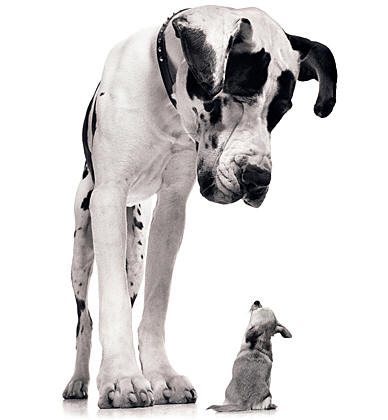 Researchers at the National Human Genome Research Institute have located genes responsible for small size in dogs. Humans have been modifying dogs for millennia through selective breeding for an array of traits, including the ability to crawl in small holes searching for vermin. The researchers claim this will illuminate human disease linked to mutations affecting growth. From ENN:
So he began the Georgie project, studying the genes of the Portuguese
water dog, a breed that comes in a wide range of sizes from 25 pounds
to 75 pounds.
Ostrander and colleagues then extended that to a range of large
and small breeds and the researchers located a section of DNA that
varied between large and small breeds in most cases.
Known as a regulatory sequence, the difference is on dog
chromosome 15 next to a previously known gene named IGF1, for
insulin-like growth factor 1. The hormone controlled by the IGF1 gene
helps mammals — including people — grow from birth to adolescence.
In small dog breeds a mutation in the sequence next to the gene kept them from growing larger, the researchers said…
…Overall, 21 researchers studied 3,241 dogs from 143 breeds,
ranging from bichon frise, Chihuahua, Maltese, Pomeranian, toy poodle,
pug and Pekingese to Saint Bernard, Newfoundland, mastiff, Great Dane,
Irish wolfhound and standard poodle.
Dogs are descended from wolves, having been domesticated 12,000
to 15,000 years ago. Selective breeding has produced the many different
types of dogs that exist today.
Judging from ancient artwork, small breeds were developed quite early, Lark said.
A study of several hundred modern wolves didn’t find any with
the small-dog marker, he said, but it is possible there were small
wolves in ancient times.
"If you’re a primitive man you would adopt the small wolf, not
the big one," he said. And for a small wolf, life would have been
easier hanging around people looking for scraps than competing with
larger wolves in the wild.
I think we can assume this will lead to new and exciting breeds as well, like the Great Dachshund or Miniature Irish Wolfhound.

What to do when you spill a large coffee on your keyboard? Yesterday my HP m7070n’s keyboard was doused with a large Tim Horton’s (top left), rendering the keys profoundly..stuck. Today’s solution involved the removal of the top of the keyboard, finding a 3 yr old to bathe the sticky keys, and sun drying. And it worked.
it really is. Via Primordial Blog, this poor kid’s brain is being malformed by his particular brand of home-schooling.
 iBiome