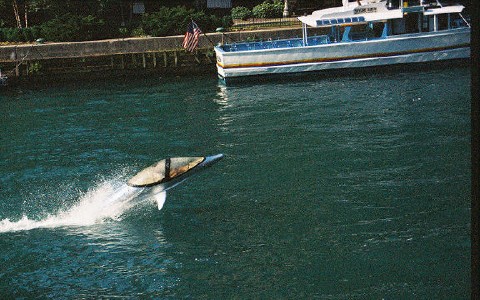
Spotted by Javier Martí, the SeaBreacher! I wonder if you can fit some torpedoes onto this beast.
Another cool toy
Reply
Spotted by Javier Martí, the SeaBreacher! I wonder if you can fit some torpedoes onto this beast.

via: Evolving Thoughts. EcoGeeks on Biodiversity
A few weeks ago my six year old daughter attended a presentation on sexual health at her school, put on by Saleema Noon. Yesterday the presentation paid its first dividend. My daughter and her friends found a used condom in the schoolyard. Recognizing what it was, they called a teacher who had it removed. While waiting for the teacher, another kid picked up the condom and insisted it was a balloon, against the protests of his classmates, and proceeded to play with it. Trust me when I say I am grateful my six year old sees a condom to avoid, rather than a balloon to play with. Early education in sexual health is a good thing.
And they think so in Bali too:
Balinese teenagers, said the Doctor, preferred to have information and
advice about sex to come from their teachers, rather than their
parents, not surprisingly, and so Murjana urged that sex education be
adopted as part of the national school curriculum, and not only taught
in the biology classes of the science stream (IPA) at senior high
school as at present. Such education should begin at junior high
school, he added.
Apparently James Cameron thinks he has discovered the remains of Jesus Christ, and will reveal all on the Discovery Channel this Sunday. Putting aside the likelihood of this Jesus being THE Jesus (I’m skeptical, to put it midly), this part of the article caught my attention:
The human remains were analyzed by Carney Matheson, a scientist at
the Paleo-DNA Laboratory at Lakehead University in Ontario, Canada.
Mitochondrial DNA examination determined the individual in the Jesus
ossuary and the person in the ossuary linked to Mary Magdalene were not
related.
You inherit your mitochondria from your mother only – it is in the ovum before fertilization. So doesn’t this only tell us that the two individuals did not have the same mother? Couldn’t they have the same father? Given maternal death rates in those days, it would hardly be unusual for a lot of families to include a variety of half-siblings. Not sure what I’m missing here.

This article in the Globe and Mail (Genetic maps help unravel black market in ivory) underscores the promise of genomics tools for compliance and enforcement of conservation laws.
Dr. Wasser was asked to help in 2002, when the authorities in
Singapore seized a huge shipment of contraband ivory. Investigators
from a number of countries wanted to know where it had come from, and
he had developed a technique for matching the genetic material found in
tusks to the DNA found in feces of elephants, allowing him to pinpoint
where the tusks came from.There were 532 tusks in the shipment, plus more than 40,000 hunks of
ivory already cut up to make the ivory seals. Between 3,000 and 6,500
elephants were likely killed to get that much ivory, the scientists
say.The DNA showed the elephants came from central Zambia, a country
that has not been given permission to sell its ivory stockpiles
internationally. The government wanted to sell ivory taken from animals
killed prior to 1989, and said that only 135 elephants had been
illegally killed over the past 10 years.
Through genetic maps and the identification of biomarkers for specific populations, authorities will increasingly be able to determine the provenance of a given piece of ivory, can of abalone, or sockeye fillet. A quick and reliable test for biomarkers of threatened species will tighten the screws on the middlemen who trade with dodgy sources, and that is a good thing.
The original PNAS article is here.
Found my YouTube of the day at Andrew Sullivan. This fellow has managed to attach a jet engine and wings to his back and instead of achieving a Darwin Award, produces some very cool footage. Forget the iPhone, I want one of these.
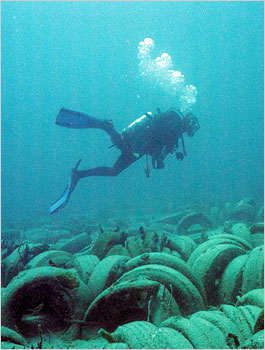
Back in my coastal management days in Indonesia there was a lot of discussion about the utility of constructing artificial reefs to enhance biodiversity and act as nurseries for fish. Sunken ships and tires were among the leading candidates for artifical reef construction. taking care of a waste management issues as well as providing ecological benefits. This story in the IHT idicates the tire idea hasn’t worked so well. Link: A 1970s plan for a tire reef off Florida turns into an ecological disaster:
A well-intentioned attempt in 1972 to create what was touted as the
world’s largest artificial reef made of tires has become an ecological
disaster.The idea was simple: Create new marine habitat and alternative dive
sites to relieve pressure on natural reefs, while disposing of tires
that were clogging landfills.Decades later, it is clear the plan failed miserably.
Little sea life has formed on the tires. Some of the bundles bound
together with nylon and steel have broken loose and are scouring the
ocean floor across a nearly two-mile, or three-kilometer, swath. Tires
are washing up on beaches.Thousands of them have wedged up against the nearby natural reef
about 70 feet, or 20 meters, below the sea surface, blocking coral
growth and devastating marine life. Similar problems have been reported
at tire reefs worldwide."They’re a constantly killing coral- destruction machine," said
William Nuckols, coordinator for Coastal America, a federal group
involved in organizing a cleanup effort that includes county
biologists, state scientists and U.S. Army and Navy salvage divers.
Link: LiveScience.com
Following ice shelf collapses
in Antarctica, researchers have gained access to sea bed areas previously accessible only through holes drilled through 100 m – thick ice. Among the new creatures discovered is the Antarctic octopus (Paraledone turqueti) (below- Credit: E. Jorgensen, NOAA 2007):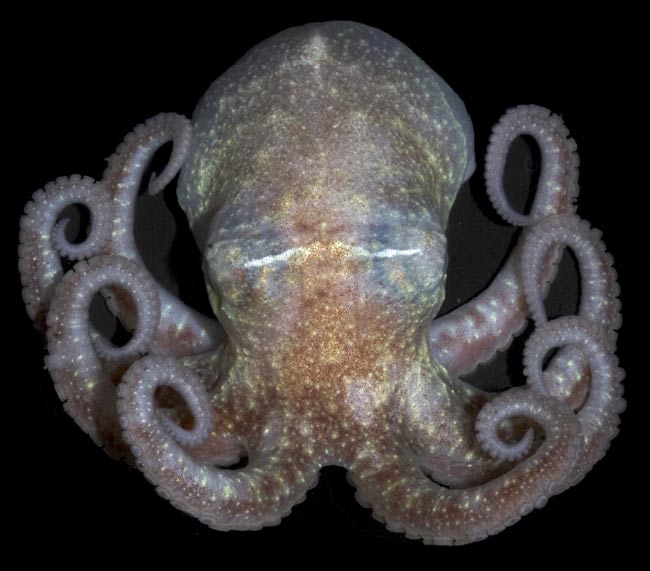
"One of
the main aims of the expedition was to survey both indigenous
life-forms and creatures that had moved in after the collapse to take
advantage of the newly opened environment.Gutt said that 95 percent of the animals the
expedition found were probably indigenous and just 5 percent had moved
in after the ice shelves collapsed, but even that small percentage
indicated a shift in biodiversity and species composition in the area which will probably continue.“Life at the sea floor obviously reacts very slowly
to this very climactic change in the environmental conditions," Gutt
said. “[It] needs hundreds to thousands of years until a new community
has fully developed, if this will happen at all.”One creature new to the neighborhood was the fast-growing, gelatinous sea squirt, which the scientists found in several dense patches."
Some insight from the discoverer of the double helix. He’s right, in my view, about the transformative effects of the falling costs of sequencing.
"Esquire: What I’ve learned"
Never fight bigger boys or dogs.
The cost of DNA sequencing is going to change the world much
faster than I would have thought. We can resequence someone now for
$150,000. Can you reach the $1,000 genome? I’m skeptical of that. But
just $15,000 would change the world. You’d do a thousand Greeks and a
thousand Swedes and find out what’s different about them. Anytime a
child has problems at school or something where you worry something is
wrong, you’ll do a DNA diagnosis.I’ve given my DNA to two of these companies. I’ve told them they
can publish everything except the structure of the gene that will tell
me if I’m predisposed to Alzheimer’s. I don’t want to know.New ideas require new facts.
You explain things by way of ideas. Why do we have a government
that is run by rich trash? Because they’ve used their money to buy the
presidency. Bush is a tool for the people who don’t want an inheritance
tax. And Frist isn’t an innocent bystander, with his own family
fortune–hundreds of millions. The piece of shit, I hate him.For all my life, America was the place to be. And we somehow
continue to be the place where there are real opportunities to change
the world for the better.I’m basically a libertarian. I don’t want to restrict anyone
from doing anything unless it’s going to harm me. I don’t want to pass
a law stopping someone from smoking. It’s just too dangerous. You lose
the concept of a free society. Since we are genetically so diverse and
our brains are so different, we’re going to have different aspirations.
The things that will satisfy me won’t satisfy you. On the other hand,
if global warming is in any way preventable and it’s likely to come,
not doing something would be irresponsible to the future of our society.
An article about the importance of genomics to the future of medicine, in the Mayo Clinic Connection:
The term "genomics" refers to the study of genes and their function. The term "genome" refers to all the genetic information each of us has in our body.
The reason medical scientists are excited about genomics is that it opens new possibilities for designing more effective and safer treatments for many diseases. Mayo Clinic is among the leading medical centers worldwide in developing new genomic therapies through its newly opened Mayo Clinic Genomics Research Center. (opens in new window)
Mayo Clinic physicians anticipate a day — not too far in the future — when physicians can look at a person’s genetic code and determine at a molecular level who’s at risk of disease, how aggressive that disease will be, and which course of treatment will be best to treat the disease without harmful side effects.
 iBiome
