I am always a bit furher behind where i should be, IT wise. What is Web 2.0? This helps:
The Machine is Me?!
Reply

I am always a bit furher behind where i should be, IT wise. What is Web 2.0? This helps:

While glancing through the current BCBusiness Magazine today, I stumbled across the stat: Marijuana sales ($7.5 billion annually) are are the #3 driver of the BC economy, after forestry ($10 billion) and Construction ($7.9 billion), and dwarfing oil and gas at a paltry $3.5 billion. I’m in the wrong corner of life sciences.
From the article:
Sadie says she’s after Triple-A weed, which is classified as the highest grade of B.C. bud and sells for about $2,000 a pound. The couple’s crop alone is worth about $10,000, she explains, and the garden replenishes itself nearly five times a year.
The size of the industry is based on an RCMP estimate rather than BC Stats, but even if the number is halved marijuana still makes a staggering contribution to the BC economy, most of it in exports. Weed dollars pour in to hardware stores, electricians, and grow-op suppliers. One supplier, Abbotsford based Advanced Nutrients, grossed $20 million in 2003. One quote estimates that there are 250,000 people involved in pot’s underground economy in BC, which would be about 17% of the province’s population.
So, what I am wondering, is how the Goliath-size of the BC Bud economy affects public policy towards enforcement. Certainly any government would have to think carefully about stamping out its 3rd largest industry.
Peat forests are a vital component of Borneo’s ecology and act as both carbon sink and habitat for a diversity of plants and wildlife. This item from the BBC Smoking out the world’s lungs highlights current threats to Borneo’s peatlands, which include logging and agricultural clearing:
According to the conservation organisation Wetlands
International, 48% of the country’s peatland forest has been
deforested, and most of the rest degraded by illegal logging. And that
has caused some major problems.Marcel Silvius, a senior programme manager for Wetlands
International, believes we are looking at one of the biggest
environmental disasters of our age."From the drainage of its peatlands alone," he told me, "Indonesia is producing 632 million tonnes of carbon dioxide a year.
"But from its annual forest fires, it produces another
1,400 million tonnes. That’s a total of 2,000 million tonnes of carbon
dioxide a year. The Netherlands emits 80 million."Indonesia’s annual forest fires are a major problem, and have been increasing over recent years.
Sometimes they are caused by companies wanting a fast, cheap way of clearing the land for planting.
Sometimes, though, it is local villagers, eking out a living from small patches of land hewn out of the forest.
I found this helpful column in the Edmonton Sun. I say helpful because it provides a useful primer on basic misunderstandings of science, particularly biology, extant in the popular press.
Choice bits:
..Because, I would assume, to believe that millions of types of fish, butterflies, rodents, polar bears and a myriad of other species will be completely and utterly wiped off the face of the Earth by global warming is to also believe that these animals are creatures entirely without the ability to adapt or evolve.
Now I could argue all the reasons why I believe that evolutionary theories are flawed, just as I can argue all of the reasons why I believe that climate change theories are flawed, too.
But I’m not going to.
Instead, I’m going to simply ask out loud why all of these threatened species
won’t be able to adapt and evolve and survive climate change….
….Meanwhile, I’ll just continue to troll the Internet looking for all the papers and studies I can find on the evidence of evolution – how bacteria can supposedly induce the necessary mutations needed to survive a hostile environment, how certain birds apparently have thicker bills during dry years when tough nuts are the only food available, and so on.
If the answer to the dilemma is that this big shift in our climate is largely manmade and moving too quickly for animals to adapt, I will just point out that every time I have expressed my skepticism about evolution on the grounds that the supposedly evolved changes in some species are irreducibly complex, and, therefore, difficult to chalk up to just random chance, it is pointed out to me that the fossil record shows few, if any, transition species, suggesting that animals can evolve with alarming speed when need be.
Often you read or hear versions of this. If a polar bear can’t pop out a few gills by 3 PM tomorrow rather than drown, then of course evolutionary theory is all wrong. Evolution (i.e. changes in species over time) is a fact, not a theory. If you believe in drug resistance or understand modern agriculture (this is what corn looked like thousands of years ago), you believe in evolution. The mechanism, natural selection as described by Darwin and Wallace, is the theoretical bit.
Firstly, the average person, including the author of above, has a tough time conceptualizing deep time – the scale of measure for evolutionary change. The "alarming speed" as referenced above is measured in tens of thousands, or millions of years for complex species. Orders of magnitude greater than the timescale over which climate change effects will take hold. Yes, many many species will adapt and change, as our prehuman ancestors did to a cold climate. Others, like the dinosaur, will disappear.
Secondly, the author fails to understand that natural selection is not about, as I mentioned before, an individual species getting a tweak and suddenly fitting in to a drastic change in environment. Natural selection is about differential survival, it’s a process of ‘culling’. Extreme events, like those that ended the age of the dinosaurs, are like a lawnmover passing across a field of flowers, missing a few remaining stems that will survive to propagate. The theory is consistent with the mass extinction worries described at the top of the quote. There is no scientific contradiction here.
Biologists are raising these alarms because they, like most Canadians, would like to avoid the mass deaths of many of our most magnificent animals and plants and, indeed, becoming part of the cull ourselves.
On February 12, 1809, 2 remarkable men were born – Abraham Lincoln and Charles Darwin.  Go celebrate. Revolutionize science or
  free a nation or something.
From the Atlantic, quoting from the Double Helix by James Watson, co-discoverer of the structure of DNA:
My interest in DNA had grown out of a desire, first picked up while a senior in college, to learn what the gene was. Later, in graduate school at Indiana University, it was my hope that the gene might be solved without my learning any chemistry. This wish partially arose from laziness since, as an undergraduate at the University of Chicago, I was principally interested in birds and managed to avoid taking any chemistry or physics courses which looked of even medium difficulty. Briefly, the Indiana biochemists encouraged me to learn organic chemistry, but after I used a Bunsen burner to warm up some benzene, I was relieved from further true chemistry. It was safer to turn out an uneducated Ph.D. than to risk another explosion …
He then went on to meet Francis Crick and the rest, as they say, is history. Is laziness an engine of success? Here’s hoping.
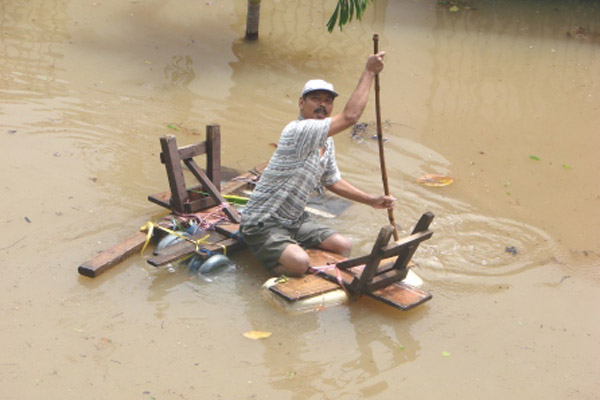
This image is from Jakarta Daily photo. The rains seem to have receded somewhat, but portions of the city remain under a brown soup.
Years ago when I lived in Jakarta it was nearly impossible to find legitimate software, and the photocopying of textbooks was a thriving business. I frequently argued with my good friend and faithful wingman Johnny about the cost/benefits of piracy and copyright infringement. It was obvious to me that to an average Indonesian small business, or university student, these intellectual properties were unaffordable at going rates. But more than that, it seemed that the promiscuous spread of pirate copies of MS Word and Windows ensured that Microsoft would become entrenched as the standard, waiting for users who would eventually be able to pay (with access to software paving the way to a more mature economy). Jeremy Wagstaff appears to be thinking the same thing.:
Actually I’ve long had the sneaking suspicion that (a) this is true.
In places like Thailand, Indonesia, Malaysia, Philippines etc, the
impressive and attractively priced range of pirated software available
raises local savvy and interest in computing. When you can buy 100
software titles for the price of a Coke, what’s not to like? And this
brings me to (b): the likes Microsoft, I suspect, actually don’t mind
this situation too much, or at least may not hate it as much as they
say.
I’m not the first to suggest this: Microsoft knows it can’t
sell legit copies of Windows or Office to every user in these places.
So it gives away what it can, or at least sells at a steep discount, to
youngsters. Businesses it tries to wrestle to the ground. The rest it
writes off. Sure, it would be great if lots of people bought legit
copies, but better that younger people are getting hooked on it, rather
than to the opposition (Linux, Ubuntu etc.) One day they’ll pay.
Jeremy is an old Asia hand, and we overlapped in Jakarta when he was with Reuters. It seems obvious that especially now, in the age of open source, microsoft wants to maintain its hold on the developing world.

Already world leaders in Salmon farming (though losing a bit of ground to the Chileans), the Norwegians are taking on the mighty cod.
Seed:
"TROMSOE, Norway (AFP)—After perfecting the art of salmon farming, Norwegians now hope to repeat the success with the trickier cod, which has been fished to near extinction in some parts of the world.
‘The success of the farmed salmon is part of the reason for the optimism we see in cod farming today,’ says Jens Oestli of the Norwegian Institute of Fisheries and Aquaculture Research in Tromsoe in northern Norway.
This Scandinavian nation began salmon farming in the 1960s. It now exports three times more farmed salmon than wild salmon, attaining 383,085 tonnes in 2005.
Cod farmers are now gambling on a similar boom."
Fish farmers in Canada are engaged in similar research, notably the Atlantic Cod Genomics And Broodstock Development project. Link. It’s obvious to me that we need to move the large-scale exploitation of sea food into an agricultural model, away from our hunter gatherer ways, or we’ll lose these resources altogether.
Heather Deal will be bringing a Climate Change motion to Council for debate next week. From the text of the motion:
WHEREAS the Fourth Assessment Report of the Intergovernmental Panel on Climate Change (IPCC) states:
o That eleven of the past twelve years rank among the twelve warmest years since 1850,
o That warming of the global climate is “unequivocal”,
o That “it is very likely that anthropogenic greenhouse gas increases caused most of the observed increase in globally averaged temperatures since the mid-20th century”
o And that “climate processes, feedbacks, and their timescales imply that anthropogenic warming and sea level rise would continue for centuries even if greenhouse gas concentrations were to be stabilized”;
AND WHEREAS the coast of British Columbia has seen its temperature rise by 0.6% over the past 100 years;
AND WHEREAS the Environment Protection Division of the BC Ministry of the Environment stated that the sea level has increased during the 20th century at a rate 10 times faster than the previous 3,000 years;
AND WHEREAS a sea-level rise would result in increased coastal erosion, flooding, and a resulting loss of coastal wetlands;
And WHEREAS sea-level rise threatens drainage, sewer and other coastal infrastructure;
AND WHEREAS, the economic importance of both the Port of Vancouver and Vancouver’s recreational/residential waterfront makes Vancouver especially vulnerable to impacts from sea-level rise in combination with storm surge events resulting from global climate change;
….etc etc….
THEREFORE BE IT RESOLVED THAT
1. Council direct staff to examine potential impacts of climate change on City of Vancouver infrastructure, including port facilities, stormwater and sewage systems (including the Iona sewage plant), seawalls and foreshore development;
2. Staff report back to Council with recommendations for measures which could be taken to mitigate these impacts, including targets, timelines and budgets;
3. In light of IPCC findings, Council affirm Vancouver’s commitment to reduce greenhouse gasses by 6% below 1990 levels by 2012, and direct staff to begin discussing more significant reduction targets beyond 2012;
4. Council request the Mayor send a letter to the Premier of British Columbia and the Prime Minister of Canada requesting that they commit to important and meaningful reductions in greenhouse gas emissions, both consistent with the Kyoto Accord and to long-term reduction targets;
5. Staff integrate community engagement around climate change issues into all City communications.
I thought that the city was already engaged in 1 & 2. I would be surprised if the designers of the Convention Centre have not built some sea level rise assumptions into the layout of the facility:
Anyone wishing to speak to the motion can contact the City Clerk’s office.
 iBiome

