The Joy of Conflict: the Five Dysfunctions of a Team

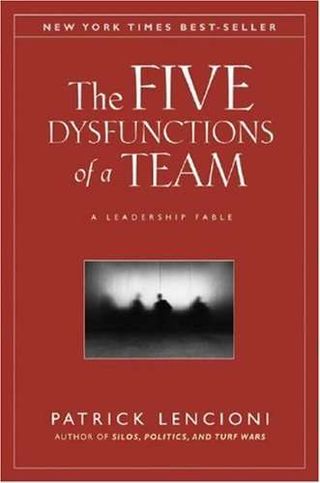
I don't typically read management / self help literature. The few times I've tried I tune out in Chapter 1, usually after the first venn diagram or matrix or list of x ways to do y.  Despite these past failures, on the recommendation of a colleague I waded into The Five Dysfunctions of a Team: A Leadership Fable, by Patrick Lencioni.  Well written, slim, and brisk, it focuses on the simple fact that in organizations, teamwork matters. The_Five_Dysfunctions_of_a_Team_A_Leadership_Fable-A talented, supportive, and accountable team offers a company a formidable competitve advantage, while companies can fly apart if dysfunctional team dynamics are allowed to take hold.  Without retelling the entire book, the interesting bit for me was the discussion of trust and conflict.  Conflict in a team can be healthy and is an indicator of trust among colleagues.  This resonated with me. The most effective groups I have worked with interact with candor and transparency.  While consensus is rarely acheived, the airing of differences and working through to resolution binds team members and promotes buy-in for even the toughest decisions.  While it can be challenging to manage constructive conflict, the alternative – silent disengagement – is far worse.  
Einstein

I just finished a wonderful biography of Albert Einstein. Well crafted and striking a happy balance between personal life and his understanding of the universe.  A number of random thoughts:Einstein

  • His major contributions were generally behind him by 1920. The theory of relativity was published in 1905. 
  • He didn't fail math.
  • A rebel and a non-conformist, he struggled to find work in academic physics until he revolutionized it.
  • Some casual conversations with a friend and a letter to Roosevelt, and the US was in the atomic bomb business.
  • Had Hitler not lost his theoretical physicists, we'd all be speaking German.
  • The Schrodinger Cat thought experiment was an approach to challenging quantum mechanics, not demonstrating it.
  • He was an A-list celebrity. Will we ever again pour such fame on a scientist? Particularly for a discovery of no practical application (at least for the next 3 decades).
  • He was the archetype absent minded scientist.
  • He was a weakly observant Jew who was offered the presidency of Israel, and turned it down.
  • He liked to sail.
  • Friendly and gentle, he was a world government pacifist.
  • His theories as described in the book are accesible and understandable, and his use of thought experiments is well described. The treatment of quantum mechanics and Einstein's rejection of 'spooky action at a distance' are satisfyingly clear.

My only regret is that I progressed through it in in fits and starts.  It's a great read.

a rare and expensive tome

Capturedata78

A colleague and I were searching for a copy of Evolution by Gene Duplication by Susumu Ohno, in part to insert some knowledge on the subject into my thick head, and Sweet Fancy Moses! it’s expensive. More than 2 Gs for a copy in good condition.  Given that it’s still the text on the subject I was shocked at how hard it is to come by.  Not even any e-versions I could find on Google.

There are copies (currently out) in the SFU and UBC libraries.  Any other options?

Into the blue tunnel

Kurt Vonnegut, Writer of Classics of the American Counterculture, Dies at 84 – New York Times.
My introduction to Vonnegut was the novel Slapstick, featuring low gravity days, the Chinese shrinking themselves to combat overpopulation (eventually becoming microscopic and infecting the rest of the world, I recall), and the church of Jesus Christ the Kidnapped. His other novels soon followed.  He was brilliant and hilarious, searing and playful, and he will be missed.

When the last living thing
has died on account of us
how poetical it would be
if Earth could say,
in a voice floating up
perhaps
from the floor
of the Grand Canyon,
“It is done.”
People did not like it here.

Asshole


Hi Ho

The Baroque Cycle

Last week I thumped The System of the World (pictured left) down on the nightstand, finally completing Neal Stephenson’s Baroque Cycle.  Generally a fan of historical fiction, I picked up the first volume, Quicksilver, at Changi Airport, Singapore in 2005, wanting something hefty for a long flight.  Now, 3000 pages  later (with many detours and interruptions), I can confidently say it was worth it.  Meticulously researched, the narrative spans roughly 1640 to 1715 encompassing religious wars, the enlightenment, the establishment of the monetary system, and the rise of the natural sciences.  In fact several of the central characters are ‘natural philosophers’ including historical figures such as Isaac Newton, Gottfried Liebniz, Robert Hooke, and John Churchill.  Stephenson skirts the supernatural in some cases, in the way Cornwell deals with the Arthurian legends in his Winter King trilogy, but otherwise these books were a perfect storm of historical fiction and science.  Loved it.

too thick

I actually hope this is not true. As the father of 2 little girls, it really turns my stomach that people like this exist.  Link: customers_suck:

My customers often annoy me. They often make me mad, and often I think they are idiots.
However, they seldom make me want to physically assault them.
Today, though, I came very close to hitting someone.
I work at a bookstore. I was cashiering today when a woman and her two kids (a boy and a girl, both somewhere between 13-15) came up to the register. The mom was buying 2 celeb gossip magazines, and the boy put down a book. The girl then walked up and set down the newest volume of the Sisterhood of the Traveling Pants series.

The mom says "You can’t buy that."
Girl: Why?
Mom: Because it’s too big.
Girl: [Brother] is buying a book that big. It’s not very expensive.
Mom: [Brother] is a boy. You’re a girl. And girls shouldn’t read big books like that. It’s too thick. Boys don’t like girls who read thick books. You want boys to like you, don’t you?

The girl went and put the book away.

via Pharyngula