Five Predictions For Biotech And Medicine In 2012 – Forbes

2. New genetic technologies will brave the valley of death. DNA sequencing is getting cheaper and making its way into hospitals. Some cancer patients (notably Christopher Hitchens and Steve Jobs) have used genetic tests to try and pick the right drugs for their tumors. But right now using DNA sequencing on patients is not making much money for companies that make DNA sequencers, such as market leader Illumina, and big funders like the National Institutes of Health are tightening their belts. The result is that the two publicly traded genomics upstarts, Pacific Biosciences of California and Complete Genomics, are trading below or near the value of the cash they have on hand.

The beneficiary so far has been Ion Torrent, the new sequencer maker bought by lab giant Life Technologies in 2010. It has been able to build a user base with its sequencing technology, an it could use this bulwark to launch a bigger attack on Illumina. The science will continue to advance. Whether its these DNA sequencer companies or next generation efforts like Foundation Medicine, the Google Ventures-backed cancer sequencing startup, is anybody’s guess.

via www.forbes.com

shared fate

Finally getting to a book I was supposed to have read in 1990 (assigned in a graduate course), I just completed Akio Morita's Made is JapanMade in japanMorita, a cofounder of SONY, offers his memories perspectives on Japan's post war economic miracle, and the birth of his company as a global electronics pioneer.  The book was published in 1986 and introduces some of the confrontations that characterized Japan / USA relations in the late 80s and 90s.  I'm actually happy to have only read this now, as it resonates more with where i am now, than the callow grad student of 1990.  In particular, the following quote stays with me:

  The most important mission for a Japanese manager is to develop a healthy relationship with his employees, to create a family-like feeling within the corporation, a feeling that employees and managers share the same fate. Those companies that are most successful in Japan are those that have managed to create a shared sense of fate among all employees, what Americans call labor and management, and the shareholders.

 A sense of shared fate and trust is critical in building a knowledge based firm that relies on attracting and retaining the best.  Wisdom from an industry giant.


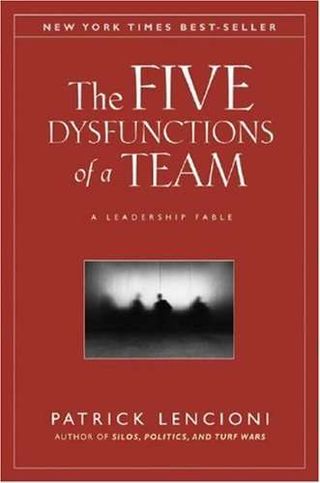
The Joy of Conflict: the Five Dysfunctions of a Team

I don't typically read management / self help literature. The few times I've tried I tune out in Chapter 1, usually after the first venn diagram or matrix or list of x ways to do y.  Despite these past failures, on the recommendation of a colleague I waded into The Five Dysfunctions of a Team: A Leadership Fable, by Patrick Lencioni.  Well written, slim, and brisk, it focuses on the simple fact that in organizations, teamwork matters. The_Five_Dysfunctions_of_a_Team_A_Leadership_Fable-A talented, supportive, and accountable team offers a company a formidable competitve advantage, while companies can fly apart if dysfunctional team dynamics are allowed to take hold.  Without retelling the entire book, the interesting bit for me was the discussion of trust and conflict.  Conflict in a team can be healthy and is an indicator of trust among colleagues.  This resonated with me. The most effective groups I have worked with interact with candor and transparency.  While consensus is rarely acheived, the airing of differences and working through to resolution binds team members and promotes buy-in for even the toughest decisions.  While it can be challenging to manage constructive conflict, the alternative – silent disengagement – is far worse.  

VC Spending in ‘Omics Field Swelled Five-Fold in Q4 ’06; Bionformatics Investment Declined

Encouraging news in genomics investments, and perhaps a bit of the shine has come off bioinformatics? While the field of bioinformatics is increasingly becoming the essential core of molecular biology, the business model is still at the blastula stage: From GenomeWeb:

Venture capital investment in the genomics, bioinformatics, and proteomics segments increased five-fold during the fourth quarter of 2006 over the same period in 2005, according to a GenomeWeb Daily News roundup of companies that disclosed receiving investments.
Venture capitalists invested around $140 million in genome tool and technology companies in the final quarter of 2006, nearly 5 times the $31.6 million they invested in the same period of 2005.
Private-equity investors flocked to genomics businesses, while venture funding among bioinformatics companies dipped slightly.
Investors spent $70 million on companies with core businesses in genomics during the fourth quarter of 2006, almost 5 times more than the $15.2 million they spent year over year.
Venture funding for businesses focused on bioinformatics over the period declined 4.4 percent to $13 million from $13.6 million in the same quarter in 2005.

Hector Jacques appointed to the Order of Canada

Hector Jacques, founder of Jacques Whitford and President for much of its 35 years, has been appointed to the  Order of Canada.  Hector is a visionary and true entrepeneur, as well as a bare knuckled businessman.  I worked for JW for 5 years or so, and it was1_fe71_jacques
Hector’s drive and policy of "hire the best, and the work will come", recognizing that the principle assets of the firm were its people,  that propelled the company to be one of the largest environmental firms in North America with 40 offices and 1600 people.  The company, at least while I was there, was very much an extension of Hector’s formidable personality.

Jacques has been elected as an Officer for his outstanding contributions to the field of engineering. “It’s a tremendous honour to be selected among thousands of outstanding citizens,” says Jacques. “Canada is a great country and I am proud to have the opportunity to contribute to its growth, with the support of so many exceptional colleagues and friends.”
Born and raised in Goa, India, Hector J. Jacques began his career in geotechnical engineering after completing his master’s degree from the Technical University of Nova Scotia, today part of Dalhousie University. In 1972, he and fellow graduate Michael Whitford founded Jacques Whitford. Starting with only a handful of employees, the firm has become one of the largest and most innovative in the environmental engineering industry. Jacques served as President and Chief Executive Officer from the firm’s inception until 2003, leading the company through remarkable growth over the years. As Jacques Whitford celebrates its 35th anniversary this year, Jacques continues to provide leadership and guidance for the company in his current role as Chairman of the Board of Directors.

Congratulations Hector, Good on ya!

“A Budding Business”

Feb07bcbbuddingbiz_1
While glancing through the current BCBusiness Magazine today, I stumbled across the stat: Marijuana sales ($7.5 billion annually) are are the #3 driver of the BC economy, after forestry ($10 billion) and Construction ($7.9 billion), and dwarfing oil and gas at a paltry $3.5 billion.  I’m in the wrong corner of life sciences. 
From the article:

Sadie says she’s after Triple-A weed, which is classified as the highest grade of B.C. bud and sells for about $2,000 a pound. The couple’s crop alone is worth about $10,000, she explains, and the garden replenishes itself nearly five times a year.

The size of the industry is based on an RCMP estimate rather than BC Stats, but even if the number is halved marijuana still makes a staggering contribution to the BC economy, most of it in exports.  Weed dollars pour in to hardware stores, electricians, and grow-op suppliers.  One supplier, Abbotsford based Advanced Nutrients, grossed $20 million in 2003.  One quote estimates that there are 250,000 people involved in pot’s underground economy in BC, which would be about 17% of the province’s population. 

So, what I am wondering, is how the Goliath-size of the BC Bud economy affects public policy towards enforcement.  Certainly any government would have to think carefully about stamping out its 3rd largest industry.