Environmental Policy news: Germany’s plan to shut down its nuclear plants will add 40 million tons of CO2 per year

Environmentalists welcomed the shift, although some demanded a faster phase-out, hoping it would spur a shift to renewable energy which they view as less harmful by avoiding radioactive waste.

But analysts say the move will also see an increase in planet-warming greenhouse gases equivalent to the annual emissions of Slovakia, as Germany uses gas and coal to plug a power generation gap, both of which are more carbon-emitting than nuclear power.

via www.enn.com

the end is nigh

Energy-related carbon-dioxide (CO2) emissions in 2010 were the highest in history, according to the latest estimates by the International Energy Agency (IEA).

After a dip in 2009 caused by the global financial crisis, emissions are estimated to have climbed to a record 30.6 Gigatonnes (Gt), a 5% jump from the previous record year in 2008, when levels reached 29.3 Gt.

In addition, the IEA has estimated that 80% of projected emissions from the power sector in 2020 are already locked in, as they will come from power plants that are currently in place or under construction today.

“This significant increase in CO2 emissions and the locking in of future emissions due to infrastructure investments represent a serious setback to our hopes of limiting the global rise in temperature to no more than 2ºC,” said Dr Fatih Birol, Chief Economist at the IEA who oversees the annual World Energy Outlook, the Agency’s flagship publication.

via www.iea.org

People being who we are, I suspect it will take extended, soaring food prices linked to crop failure to get to substantive policy and behavioural change.

Reality check

via Sullivan, nothing like actual data to bust a myth.  As Seth Godin states, fear of the unknown overrides common perceptions of workaday risk:

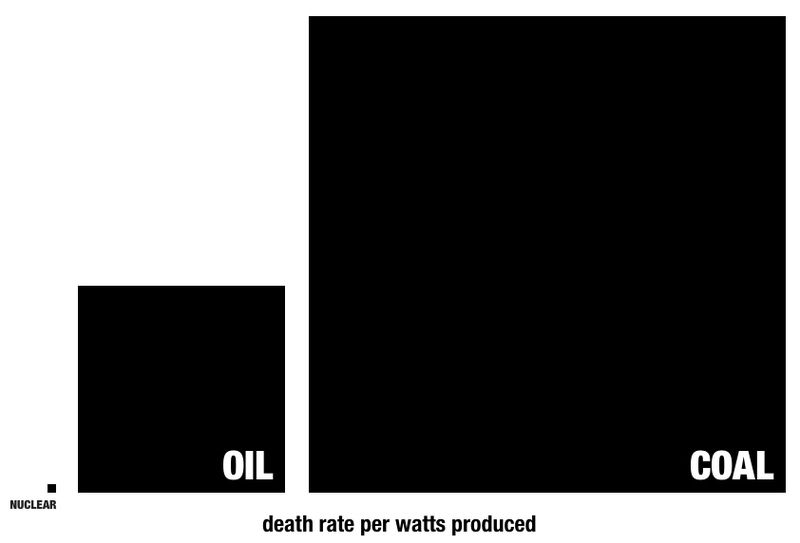
Nuclear coal oil
For every person killed by nuclear power generation, 4,000 die due to coal, adjusted for the same amount of power produced… You might very well have excellent reasons to argue for one form over another. Not the point of this post. The question is: did you know about this chart? How does it resonate with you?

Vivid is not the same as true. It's far easier to amplify sudden and horrible outcomes than it is to talk about the slow, grinding reality of day to day strife. That's just human nature. Not included in this chart are deaths due to global political instability involving oil fields, deaths from coastal flooding and deaths due to environmental impacts yet unmeasured, all of which skew it even more if you think about it.

This chart unsettles a lot of people, because there must be something wrong with it. Further proof of how easy it is to fear the unknown and accept what we've got.

via sethgodin.typepad.com

Nukes: Improve them, but don’t even think of abandoning them

It may be possible in Europe and North America to talk about reducing consumer demand for electricity and using alternatives instead of nukes. But none of that applies in Asia, Africa or South America, where the most pressing demand in the next two decades will be to turn three billion poor or impoverished people into energy consumers – ideally, high-efficiency, low-waste consumers, but certainly people able to have street lighting and refrigerators.

To do this without nuclear power would either be ecologically catastrophic, because it would rely on more coal-fired generation than the world has seen, or murderously inhumane, because it would raise energy prices to levels that would keep people in terrible poverty.

The world needs two things now: fewer carbon emissions, and a growing supply of energy at a low cost. By accomplishing both, nuclear power, even factoring in disasters, can save millions of lives.

Some leading environmentalists this week immediately recognized the danger of abandoning nuclear power. The British arch-Green activist George Monbiot wrote a cri de coeur on Thursday urging countries to stay with nuclear: “Even when nuclear power plants go horribly wrong, they do less damage to the planet and its people than coal-burning stations operating normally,” he wrote, rightly.

“Coal, the most carbon-dense of fossil fuels, is the primary driver of human-caused climate change. If its combustion is not curtailed, it could kill millions of times more people than nuclear power plants have done so far. … Abandoning nuclear power as an option narrows our choices just when we need to be thinking as broadly as possible.”

via www.theglobeandmail.com

We need nuclear power, and lots more of it, if we want to effectively curb climate change.

Soaring Food Prices. A result of climate change?

Krugman:

Overall grain production is down — and it’s down substantially more when you take account of a growing world population. Wheat production (this time not per capita) is way down.

You might ask why a production shortfall of 5 percent leads to a doubling of prices. Part of the answer is that some kinds of demand are growing faster than population — in particular, China is becoming a growing importer of feed to meet the demand for meat. But the main point is that the demand for grain is highly price-inelastic: it takes big price rises to induce people to consume less, yet collectively that’s what they must do given the shortfall in production.

Why is production down? Most of the decline in world wheat production, and about half of the total decline in grain production, has taken place in the former Soviet Union — mainly Russia, Ukraine, and Kazakhstan. And we know what that’s about: an incredible, unprecedented heat wave.

Obligatory disclaimer: no one event can be definitively assigned to climate change, just as you can’t necessarily claim that any one of the fender-benders taking place right now in central New Jersey was caused by the sheet of black ice currently coating our roads. But it sure looks like climate change is a major culprit.

via krugman.blogs.nytimes.com

German Military Study Warns of Finite Oil and Economic Crisis

Oil is a precious and finite resource, which is why the blocking of conversation measures, including those designed to combat climate change, exposes us to a broad spectrum of security issues, from direct impacts associated with climate change, to economic dislocation driven by soaring fuel costs.

The study was produced by the Future Analysis department of the Bundeswehr Transformation Center, a branch of the German military. It was leaked in August, and its authenticity was confirmed last week by the German newspaper Der Spiegel.

The study states that there is “some probability that peak oil will occur around the year 2010 and that the impact on security is expected to be felt 15 to 30 years later.”

The concept of “peak oil” is a controversial one, as it signifies the point at which global oil production reaches its maximum level and then enters a permanent decline. As oil is a finite resource, most energy experts consider the eventual peak and decline of world oil production to be an inevitable reality.

……

The German military study, which was analyzed and partly translated into English by Der Spiegel, declares that once peak oil begins in earnest, economies around the globe — including Germany’s — will probably struggle with price shocks as a result of higher transportation costs, and “shortages of vital goods could arise.”

via green.blogs.nytimes.com

Road warrior humungous

Coming soon to a neighbourhood near you.

another worm turns: Noted anti-global-warming scientist reverses course |

after years pressing his thumb on the denialist end of the scale, Bjorn Lomborg sees the light (feels the heat?).

With scientific data piling up showing that the world has reached its hottest-ever point in recorded history, global-warming skeptics are facing a high-profile defection from their ranks. Bjorn Lomborg, author of the influential tract "The Skeptical Environmentalist," has reversed course on the urgency of global warming, and is now calling for action on "a challenge humanity must confront."

………

Lomborg's essential argument was: Yes, global warming is real and human behavior is the main reason for it, but the world has far more important things to worry about.

Oh, how times have changed.

In a book to be published this year, Lomborg calls global warming "undoubtedly one of the chief concerns facing the world today" and calls for the world's governments to invest tens of billions of dollars annually to fight climate change.

via news.yahoo.com

Reducing our carbon footprint with the direct purchase of renewable energy

Google enters a long term purchase agreement with an Iowa wind farm.

We just completed a substantial 20-year green Power Purchase Agreement that allows us to take responsibility for our footprint and foster true growth in the renewable energy sector. On July 30 we will begin purchasing the clean energy from 114 megawatts of wind generation at the NextEra Energy Resources Story County II facility in Iowa at a predetermined rate for 20 years. Incorporating such a large amount of wind power into our portfolio is tricky (read more about how the deal is structured), but this power is enough to supply several data centers.

via googleblog.blogspot.com

No “Climategate” – UK lawmakers take heat off ‘Climategate’ scientist – CNN.com

The UK scientist at the center of the "Climategate" controversy over leaked e-mails has been cleared of hiding or manipulating data by a parliamentary committee.

But lawmakers who had been investigating the row over global warming science said in a report published Wednesday that climate scientists must publish all their raw data and methods to ensure the research is "irreproachable."

The Climatic Research Unit (CRU) of the University of East Anglia in eastern England has been under fire since last November when emails, which skeptics claimed showed scientists hiding and manipulating climate data, were allegedly hacked and leaked onto the Internet.

…..

The Commons report said the leaked emails suggested a "blunt refusal"
by Jones to share scientific data but its chairman Phil Willis said
there was no evidence that Jones hid or manipulated data to back up his
own science.

"The focus on Professor Jones and CRU has been
largely misplaced," the report said. "On the accusations relating to
Professor Jones's refusal to share raw data and computer codes, the
committee considers that his actions were in line with common practice
in the climate science community but that those practices need to
change."

Continue reading