Apple, Climate Change, and the Chamber of Commerce

I agree with almost everything Matt Yglesias says here about the Chamber of Commerce and their stance on climate change, particularly in the context of the departure of high profile companies like Apple from the Chamber.  I don't see how opposition to climate change policy can be in the interests, even short term, of their corporate stakeholders.

The fundamental problem the Chamber of Commerce is going to have on this is that they’re really really wrong. Not like how they’re morally wrong about, say, labor rights or workplace safety rules. They’re analytically mistaken about the interests of the United States business community. If we take action to avert ecological catastrophe, economic growth will still happen. Capitalism will march on. Big companies will be big, and people will earn lots of money managing them. Yes, the present-day owners of coal companies or manufacturers specifically wedded to unusually energy-intensive processes will be in trouble. But “business” in a broad and general sense will keep on keeping on. People will still want gadgets and furniture, will shop at stores, will buy and sell, and generally keep being customers for business.


The real risk is being run by doing nothing. It’s doing nothing that might end the party, and lead to various kinds of nightmare scenarios. And over time, more and more firms are going to see that they have no particular stake in underpricing pollution. One maybe of the Chamber board is a guy from Anheuser-Busch. A serious climate bill’s not going to put him out of business. Nor, to just pick board affiliated companies whose lines of business I recognize, is it going to put State Farm Insurance or IBM or AT&T or Pfizer or Accenture out of business. But the executives at those companies and their kids and their customers are all going to face all the problems caused by untrammeled climate change. And why, genuinely, should a pharmaceutical company or a telecom company be fighting to stop people from stopping an ecological disaster? It genuinely doesn’t make sense.
via yglesias.thinkprogress.org

i love everything about this idea

Yale Environment 360: Google Develops Meter<br />To Closely Track Home Power Usage.
Google is developing a “PowerMeter” that will allow homeowners and businesses to closely track electricity usage of appliances, heaters, and other devices on their computers. The PowerMeter represents the search engine giant’s entry into the world of smart meter technology, which enables consumers to reduce energy consumption by instantaneously monitoring the sources of power consumption in their homes and offices…..

I think enabling people to associate household activities with spikes in power consumption is a leap forward in behaviour modification, and changes in consumer choices.  Watching the slow burn of lights in an unoccupied room would get a lot of people to the 'off' switch.

“It seems obvious to me that if you give (energy) information to end users they behave smartly.”

Yes.

New SUPER DUPER SECRET evidence that climate change isn’t real

Prominent right wing columnist Fred Barnes claims the case for man made warming is "falling apart" and gets a call from Talking Points Memo:

TPMMuckraker | Talking Points Memo | Barnes;
We hadn't heard anything lately about the case for man-made global warming falling apart. In fact, just the opposite. So we called Barnes and asked him what he was referring to.

At first, he cited the fact that it's been cold lately.

Perhaps sensing this was less than convincing, Barnes then asserted that there had been a "cooling spell" in recent years. "Haven't you noticed?" he asked.

Asked for firmer evidence of such cooling, Barnes demurred, telling TPMmuckraker he was too busy to track it down.

We pressed Barnes again: surely he could tell us where he had found this vital new information, which could upend the current debate over how to address global warming.


In response, Barnes said only that he knew where he had found it, but would not tell us,
apparently as a matter of principle. "I'm not going to do your research for you," he eventually said, before hurriedly ending the call.

My emphasis.  These guys crack me up.

Revealed: the environmental impact of Google searches – Times Online

Interesting to see e-activities described in CO2, and to note that the benefits of 'paperless' transactions have balancing costs. 

Times Online.

Performing two Google searches from a desktop computer can generate about the same amount of carbon dioxide as boiling a kettle for a cup of tea, according to new research.
While millions of people tap into Google without considering the environment, a typical search generates about 7g of CO2 Boiling a kettle generates about 15g. “Google operates huge data centres around the world that consume a great deal of power,” said Alex Wissner-Gross, a Harvard University physicist whose research on the environmental impact of computing is due out soon. “A Google search has a definite environmental impact.”

As mentioned later in the article, what the IT burn is displacing is key.  My view is that through entertainment and social networking we are increasing the carbon footprint of our personal lives.

If your internet use is in place of more energy-intensive activities, such as
driving your car to the shops, that’s good. But if it is adding activities
and energy consumption that would not otherwise happen, that may pose
problems.

Newcombe cites Second Life and Twitter, a rapidly growing website whose 3m
users post millions of messages a month. Last week Stephen Fry, the TV
presenter, was posting “tweets” from New Zealand, imparting such vital
information as “Arrived in Queenstown. Hurrah. Full of bungy jumping and
‘activewear’ shops”, and “Honestly. NZ weather makes UK look stable and
clement”.

Global Warming is Over? Yay!

PC240117 I have noticed a lot of opinion traffic, like this, seizing on the recent cold snaps across North America and spinning it as an end to Climate Change theory.    Now I am no climate change expert by any means, and I sure as hell would like the scientific consensus to be wrong (see recent Vancouver photo at right), so I dropped in on RealClimate to see what's going on.

So what to make of the latest year's data? First off, we expect that there will be oscillations in the global mean temperature. No climate model has ever shown a year-on-year increase in temperatures because of the currently expected amount of global warming. A big factor in those oscillations is ENSO – whether there is a a warm El Niño event, or a cool La Niña event makes an appreciable difference in the global mean anomalies – about 0.1 to 0.2ºC for significant events. There was a significant La Niña at the beginning of this year (and that is fully included in the D-N annual mean), and that undoubtedly played a role in this year's relative coolness. It's worth pointing out that 2000 also had a similarly sized La Niña but was notably cooler than this last year.

While ENSO is one factor in the annual variability, it is not the only one. There are both other sources of internal variability and external forcings. The other internal variations can be a little difficult to characterise (it isn't as simple as just a super-position of all the climate acronyms you ever heard of NAO+SAM+PDO+AMO+MJO etc.), but the external (natural) forcings are a little easier. The two main ones are volcanic variability and solar forcing. There have been no climatically significant volcanoes since 1991, and so that is not a factor. However, we \are at a solar minimum. The impacts of the solar cycle on the surface temperature record are somewhat disputed, but it might be as large as 0.1ºC from solar min to solar max, with a lag of a year or two. Thus for 2008, one might expect a deviation below trend (the difference between mean solar and solar min, and expecting the impact to not yet be fully felt) of up to 0.05ºC. Not a very big signal, and not one that would shift the rankings significantly.

There were a number of rather overheated claimsearlier this year that 'all the global warming had been erased' by the La Niña-related anomaly. This was always ridiculous, and now that most of that anomaly has passed, we aren't holding our breath waiting for the 'global warming is now back' headlines from the same sources.

Biofuels vs Orangutans

It’s starting to look alarmingly like the pursuit of biofuels will be the next poster child for the Law of Unintended Consequences – up there with thalidomide and turning cattle into cannibals. Borneo’s forests have been under siege for some time by the agricultural industry, transmigrants, and the mining industry.  Demands for "environmentally friendly" energy might just drive the last chainsaw to the last tree.  I’m starting to think these guys have a point.

Link: Environmental News Network.

Despite government claims pristine jungles are escaping the effects
of the "green solution" to the energy crunch, the boom is threatening
the survival of animals like the endangered orangutan and turning the
country into a major global warming contributor, environmentalists say…

…Palm oil
plantations have long been a staple of the economies of tropical
Indonesia and neighboring Malaysia. Oil made from the red, spiky
apple-sized fruit is used to make a vast range of products, from soap
to chocolate to lipstick.

But concern over pollution
from the burning of fossil fuels in Europe and the United States has
led to a new use for the oil – mixing it with diesel to make a cleaner
burning and cheaper fuel to put in cars.

The
EU parliament this year announced a renewed push to meet sustainable
energy targets, including mandating using biofuels to supply at least
10 percent of transport fuel needs by 2020.

Encouraged
by government tax breaks, many of Indonesia’s largest conglomerates as
well as foreign companies are investing millions in expanding
plantations and refining facilities on Borneo, which has one of the
richest ecosystems in the world and is one of the only remaining homes
of the orangutans.

Continue reading

Microarrays and Climate Change

From  Technology Review, new applications of genomics tools, in this case microarray technology, to model the effects of climate change on marine species at the gene expression level:

Using novel genomic technology, marine biologists have found troubling
clues that marine life could be extremely vulnerable to climate change.
By mimicking future ocean climes and using gene chips to detect how
marine organisms respond, the researchers can evaluate how well
different organisms deal with environmental stress. The findings, while
still preliminary and incomplete, are worrisome…

…So far, the team has focused its attention on a set of proteins, known
as heat-shock proteins, which kick in when an animal is under stress.
Almost all animals carry copies of these proteins, which can repair
other proteins that have been bent out of shape by heat and additional
environmental stresses. According to early results from gene-chip
studies, sea-urchin larvae raised at current carbon levels activate
their heat-shock proteins when faced with warming water temperatures.
But larvae raised at the best-case-scenario carbon level no longer
activate these genes under stress and therefore can’t respond to a
warming climate. "I don’t want to say we will lose all sea urchins,"
says Hoffman. "But there will be some part of the population that can’t
develop."…

…Although it’s hard to predict exactly how that loss will affect the
environment, it’s likely to change the structure of the entire
ecosystem. Without algae-eating urchins, "you might predict that algae
will become dominant in a particular area, which then might affect
availability of fish that live there, which could affect the fishing
industry or even tourism," Hoffman says.

While illuminating some of the useful applications of genomics to conservation, I find this article a bit alarmist.  As pointed out by a commenter on the article, sea urchins have faced warmer oceans in the past and survived.  There will be transition and loss, and a new equilibrium. The key point for we humans is whether the transition and new equilibrium significantly affects us, and how.

Strange New Creatures Found in Antarctica

Link: LiveScience.com

Following ice shelf collapses
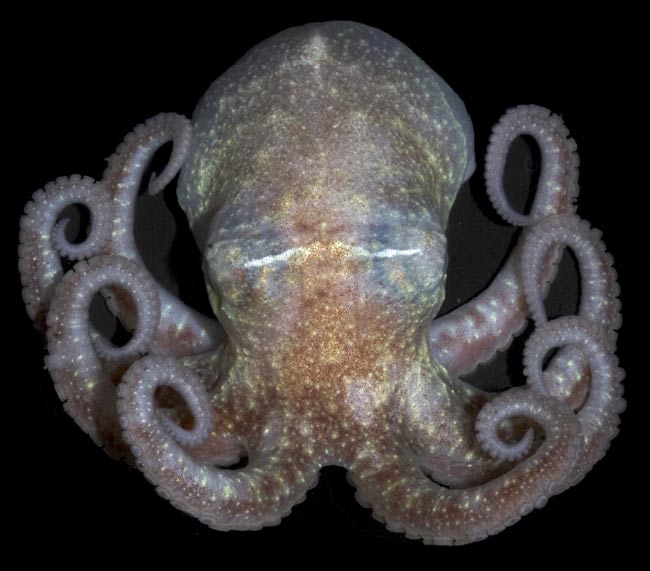
in Antarctica, researchers have gained access to sea bed areas previously accessible only through holes drilled through 100 m – thick ice. Among the new creatures discovered is the Antarctic octopus (Paraledone turqueti) (below- Credit: E. Jorgensen, NOAA 2007):070225_antarctic_octopus_02 

"One of
the main aims of the expedition was to survey both indigenous
life-forms and creatures that had moved in after the collapse to take
advantage of the newly opened environment.

Gutt said that 95 percent of the animals the
expedition found were probably indigenous and just 5 percent had moved
in after the ice shelves collapsed, but even that small percentage
indicated a shift in biodiversity and species composition in the area which will probably continue.

“Life at the sea floor obviously reacts very slowly
to this very climactic change in the environmental conditions," Gutt
said. “[It] needs hundreds to thousands of years until a new community
has fully developed, if this will happen at all.”

One creature new to the neighborhood was the fast-growing, gelatinous sea squirt, which the scientists found in several dense patches."

“The evolution of warming”

I found this helpful column in the Edmonton Sun. I say helpful because it provides a useful primer on basic misunderstandings of science, particularly biology, extant in the popular press.

Choice bits:

..Because, I would assume, to believe that millions of types of fish, butterflies, rodents, polar bears and a myriad of other species will be completely and utterly wiped off the face of the Earth by global warming is to also believe that these animals are creatures entirely without the ability to adapt or evolve.

Now I could argue all the reasons why I believe that evolutionary theories are flawed, just as I can argue all of the reasons why I believe that climate change theories are flawed, too.

But I’m not going to.

Instead, I’m going to simply ask out loud why all of these threatened species
won’t be able to adapt and evolve and survive climate change….


….Meanwhile, I’ll just continue to troll the Internet looking for all the papers and studies I can find on the evidence of evolution – how bacteria can supposedly induce the necessary mutations needed to survive a hostile environment, how certain birds apparently have thicker bills during dry years when tough nuts are the only food available, and so on.
If the answer to the dilemma is that this big shift in our climate is largely manmade and moving too quickly for animals to adapt, I will just point out that every time I have expressed my skepticism about evolution on the grounds that the supposedly evolved changes in some species are irreducibly complex, and, therefore, difficult to chalk up to just random chance, it is pointed out to me that the fossil record shows few, if any, transition species, suggesting that animals can evolve with alarming speed when need be.

Often you read or hear versions of this. If a polar bear can’t pop out a few gills by 3 PM tomorrow rather than drown, then of course evolutionary theory is all wrong.  Evolution (i.e. changes in species over time) is a fact, not a theory.  If you believe in drug resistance or understand modern agriculture (this is what corn looked like thousands of years ago), you believe in evolution.  The mechanism, natural selection as described by Darwin and Wallace, is the theoretical bit.

Firstly, the average person, including the author of above, has a tough time conceptualizing deep time – the scale of measure for evolutionary change.  The "alarming speed" as referenced above is measured in tens of thousands, or millions of years for complex species.  Orders of magnitude greater than the timescale over which climate change effects will take hold.  Yes, many many species will adapt and change, as our prehuman ancestors did to a cold climate. Others, like the dinosaur, will disappear.

Secondly, the author fails to understand that natural selection is not about, as I mentioned before, an individual species getting a tweak and suddenly fitting in to a drastic change in environment. Natural selection is about differential survival, it’s a process of ‘culling’. Extreme events, like those that ended the age of the dinosaurs, are like a lawnmover passing across a field of flowers, missing  a few remaining stems that will survive to propagate.  The theory is consistent with the mass extinction worries described at the top of the quote.  There is no scientific contradiction here.

Biologists are raising these alarms because they, like most Canadians, would like to avoid the mass deaths of many of our most magnificent animals and plants and, indeed, becoming part of the cull ourselves.

Vancouver and Climate Change

Heather Deal will be bringing a Climate Change motion to Council for debate next week. From the text of the motion:

WHEREAS the Fourth Assessment Report of the Intergovernmental Panel on Climate Change (IPCC) states:
o That eleven of the past twelve years rank among the twelve warmest years since 1850,
o That warming of the global climate is “unequivocal”,
o That “it is very likely that anthropogenic greenhouse gas increases caused most of the observed increase in globally averaged temperatures since the mid-20th century”
o And that “climate processes, feedbacks, and their timescales imply that anthropogenic warming and sea level rise would continue for centuries even if greenhouse gas concentrations were to be stabilized”;
AND WHEREAS the coast of British Columbia has seen its temperature rise by 0.6% over the past 100 years;
AND WHEREAS the Environment Protection Division of the BC Ministry of the Environment stated that the sea level has increased during the 20th century at a rate 10 times faster than the previous 3,000 years;
AND WHEREAS a sea-level rise would result in increased coastal erosion, flooding, and a resulting loss of coastal wetlands;
And WHEREAS sea-level rise threatens drainage, sewer and other coastal infrastructure;
AND WHEREAS, the economic importance of both the Port of Vancouver and Vancouver’s recreational/residential waterfront makes Vancouver especially vulnerable to impacts from sea-level rise in combination with storm surge events resulting from global climate change;

….etc etc….

THEREFORE BE IT RESOLVED THAT
1. Council direct staff to examine potential impacts of climate change on City of Vancouver infrastructure, including port facilities, stormwater and sewage systems (including the Iona sewage plant), seawalls and foreshore development;
2. Staff report back to Council with recommendations for measures which could be taken to mitigate these impacts, including targets, timelines and budgets;
3. In light of IPCC findings, Council affirm Vancouver’s commitment to reduce greenhouse gasses by 6% below 1990 levels by 2012, and direct staff to begin discussing more significant reduction targets beyond 2012;
4. Council request the Mayor send a letter to the Premier of British Columbia and the Prime Minister of Canada requesting that they commit to important and meaningful reductions in greenhouse gas emissions, both consistent with the Kyoto Accord and to long-term reduction targets;
5. Staff integrate community engagement around climate change issues into all City communications.

I thought that the city was already engaged in 1 & 2.  I would be surprised if the designers of the Convention Centre have not built some sea level rise assumptions into the layout of the facility:
Anyone wishing to speak to the motion can contact the City Clerk’s office.