Alfred Russel Wallace goes online

"What this should hopefully do is result in a major upgrade in the quality of writing about Wallace," the historian told BBC News.

"Next year is the centenary of his death. Just like 2009 was the big Darwin year, 2013 will be the big Wallace year. And I hope now that people have access to all of his literature, it will make a big difference to what they say and write about him."

Wallace Online gathers together in one place for the first time all of the naturalist's writings and illustrations.

There are 28,000 pages of searchable documents and 22,000 images. Among the online gems is that first announcement of the theory of evolution delivered to a London scientific meeting 154 years ago.

Collections It remains one of the great coincidences in scientific history that the one person Wallace should choose to approach to share his ideas on natural selection was the only other scientist who separately had come to the same conclusions – Charles Darwin.

via www.bbc.co.uk
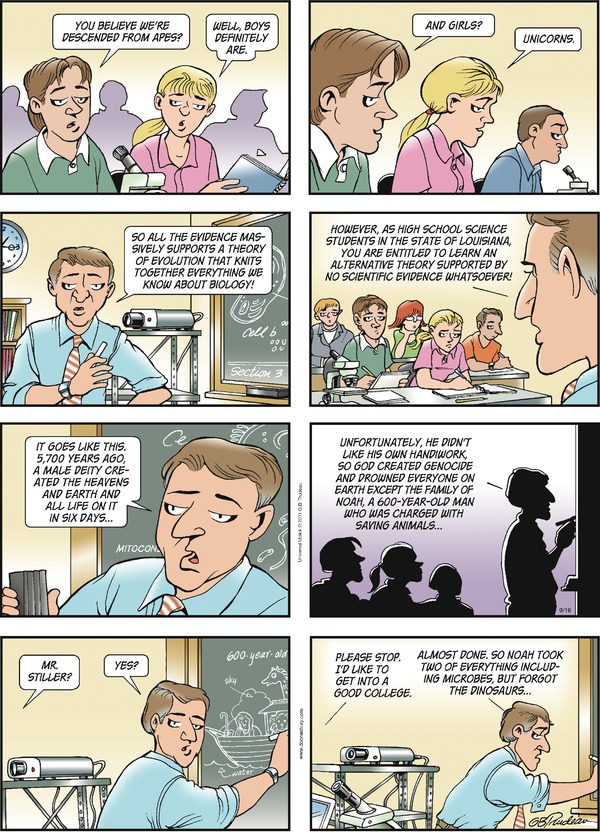
Richard Dawkins celebrates a victory over creationists

Leading scientists and naturalists, including Professor Richard Dawkins and Sir David Attenborough, are claiming a victory over the creationist movement after the government ratified measures that will bar anti-evolution groups from teaching creationism in science classes.

The Department for Education has revised its model funding agreement, allowing the education secretary to withdraw cash from schools that fail to meet strict criteria relating to what they teach. Under the new agreement, funding will be withdrawn for any free school that teaches what it claims are "evidence-based views or theories" that run "contrary to established scientific and/or historical evidence and explanations".

The British Humanist Association (BHA), which has led a campaign against creationism – the movement that denies Darwinian evolution and claims that the Earth and all its life was created by God – described the move as "highly significant" and predicted that it would have implications for other faith groups looking to run schools.

via www.guardian.co.uk

BioImplement: New Series on Complexity and Evolution

So into the breach, I add my voice with some new arguments, after this small bit of throat-clearing. I will try to avoid being derivative as I come armed with my own capacity for inquiry, insight, and argument. My examples will show how ID concepts force the gerrymandering of human design history, and surround it with mystical borders to make their claims. The individual steps in human design are small, slow and absolutely require the intellectual imprinting of lessons by trial and error. Students who are led to think falsely about human design, or any complexity as having mystical origins are harmed by the diminishment of their own aspirations of creativity. We all need to understand how small steps and tools lead to human creativity and any object of complexity. I will reveal these small steps and show, where I can, the failures that led to success.

via bioimplement.blogspot.com

Chris Hogue has re-entered the blogosphere with a riff on how we can be informed by incrementalism in human design and evolutionary process, and understand the path to complexity. I'm looking forward to the next post. Hopefully soon.

A new theory emerges for where some fish became 4-limbed creatures

"These transitional fossils were not associated with drying ponds or deserts, but consistently were found with humid woodland soils," he said. "Remains of drying ponds and desert soils also are known and are littered with fossil fish, but none of our distant ancestors. Judging from where their fossils were found, transitional forms between fish and amphibians lived in wooded floodplains. Our distant ancestors were not so much foolhardy, as opportunistic, taking advantage of floodplains and lakes choked with roots and logs for the first time in geological history."

Limbs proved handy for negotiating woody obstacles, and flexible necks allowed for feeding in shallow water, Retallack said. By this new woodland hypothesis, the limbs and necks, which distinguish salamanders from fish, did not arise from reckless adventure in deserts, but rather were nurtured by a newly evolved habitat of humid, wooded floodplains.

The findings, he said, dampen both the desert hypothesis of Romer and a newer inter-tidal theory put forth by Grzegorz Niedbwiedzki and colleagues at the University of Warsaw. In 2010, they published their discovery of eight-foot-long, 395-million-year-old tetrapods in ancient lagoonal mud in southeastern Poland, where Retallack also has been studying fossil soils with Polish colleague Marek Narkeiwicz.

via www.eurekalert.org

This evolutionary pathway can be imagined when you consider floodplains such as Tonle Sap, where during the monsoon the river reverses flow and the fish breed and thrive among a submerged forest.

Salmon Genome in Final Phases of Completion

The International Cooperation to Sequence the Atlantic Salmon Genome (ICSASG, the "Cooperation") has awarded the Phase II contract for next-generation sequencing and analysis of the Atlantic salmon genome to the J. Craig Venter Institute (JCVI) in Rockville, Maryland. The JCVI will be sequencing the salmon genome using next-generation technologies, including assembly to integrate Sanger and next-generation sequence, and comparative genomics. This effort is expected to generate a high-quality resource for those responsible for the management of wild salmon stocks and the salmon aquaculture industry, as well as providing a reference genome for work with other salmonids.

via www.bioportfolio.com

CGRASP_fish_2Great to see the Venter Institute involved in this next stage of genomic resource development for salmon. This will work feed environmental genomics, aquaculture, and our understanding of the role of gene duplication in evolution. Exciting!

The Last Neanderthal’s Love Song

O ancestors! Please hear my cry.
I'm eighteen summers old.
I need a wife, but evolution's
Left me in the cold.

I'm the last Neanderthal.
I have some woman friends—
Nice-looking, others tell me—but
They're Homo sapiens.

I'd like to meet a girl like Mom
With a rich potato form.
These sapiens are willowy;
They don't look very warm.

A woman looks her best, I think,
With low, protruding brow,
But the female forehead fashion
Is high and flat right now.

A lady's lower jaw should sink
Delicately in.
Beneath their lips, these girls have got
A pointy, prickly "chin."

A sideways egg's the pretty shape
That suits a female skull.
But modern girls have heads as round
As the moon does when it's full.

Alas, O ancestors! Alas,
Our race will not survive.
I'll never wed, and I'm the last
Neanderthal alive.

via www.steamthing.com

found this over at the Dish. It begs to be set to an Arthur Sullivan score.

a tangled bank

In celebration of the day, one of my favourite (and the final) passages in Origin:

It is interesting to contemplate a tangled bank, clothed with many
plants of many kinds, with birds singing on the bushes, with various
insects flitting about, and with worms crawling through the damp earth,
and to reflect that these elaborately constructed forms, so different
from each other, and dependent upon each other in so complex a manner,
have all been produced by laws acting around us. These laws, taken in
the largest sense, being Growth with Reproduction; Inheritance which is
almost implied by reproduction; Variability from the indirect and
direct action of the conditions of life, and from use and disuse: a
Ratio of Increase so high as to lead to a Struggle for Life, and as a
consequence to Natural Selection, entailing Divergence of Character and
the Extinction of less-improved forms. Thus, from the war of nature,
from famine and death, the most exalted object which we are capable of
conceiving, namely, the production of the higher animals, directly
follows. There is grandeur in this view of life, with its several
powers, having been originally breathed by the Creator into a few forms
or into one; and that, whilst this planet has gone cycling on according
to the fixed law of gravity, from so simple a beginning endless forms
most beautiful and most wonderful have been, and are being evolved.