Genome Canada cut good for science?

Chris Hogue weighs in and makes an excellent point about co-funding.  GC only provides 50 cent dollars, and the other 50 will be harder to find over the next few years.  Redirection of research funds to labs and other funding mechanisms may be a prudent way forward.

BioImplement: Market Driven Science in Crisis?.
While it is certain that many Genome Canada funded scientists have become international leaders in their fields, one problem is that Genome Canada has no long-term strategy to fund these projects. Industry partnered three-year projects with no provision for renewal are the staple of Genome Canada's co-funding strategy.
 
Expectations of commercial spin-offs and an market-driven afterlife is the fairy-tale ending for Genome Canada's approach to science. Yet the horizon for success in life sciences research can be longer than a decade. So, sadly, when a researcher becomes an international leader, Genome Canada has no strategy to keep them in that position, economic downturn or not.
Genome Canada is a market-driven organization.


Perhaps it is reasonable to expect that co-funding – the money contributed by industry to the Genome Canada funding scheme – will simply dry up during this recession. By its own design, Genome Canada cannot hand out its money without co-funders. If Genome Canada has no hope of attracting co-funding this year, then this budget may in fact (gasp) be a reasonable one.

And now, the walkback

Someone got a call from Industry Canada:

Researchers now pleased with budget.

The controversy continued to simmer yesterday, just as Genome Canada's board of directors issued a list of "key messages" that expressed overwhelming support for the budget. "Genome Canada is pleased with the federal government's 2009 budget in which millions will be invested in research infrastructure over the next two years," read the statement. "This is good news for the scientific community across the country."


While Genome Canada received no new funding in the 2009 budget, the board said it already has a pair of five-year funding arrangements in place with the federal government worth a total of $240-million and will be able to meet all its current funding obligations.


The organization has received $840-million in federal funding since its inception in 2000. Genome Canada received no mention in the Conservatives' first budget in 2006, but was given $100-million in new funding in 2007 and an additional $140-million last year.


No representative of Genome Canada was available yesterday to explain the group's apparent change in position on the budget, a spokeswoman said. Gary Goodyear, the Minister of State for Science and Technology, said the controversy stemmed from a "misunderstanding between a president and his board."

Genome Canada ignored in federal Budget

The budget was alarmingly silent on the future of Genome Canada, Canada's core funding source for "big science".  Genome Canada has established Canadian leadership in a range of genomics, proteomics, and bioinformatics global research initiatives. 

globeandmail.com: Budget erases funding for key science agency:

The only agency that regularly finances large-scale science in Canada was shut out of Tuesday's federal budget, putting at risk thousands of jobs and some of the most promising medical research, and forcing the country to pull out of key international projects.
For the first time in nine years, Genome Canada, a non-profit non-governmental funding organization, was not mentioned in the federal budget and saw its annual cash injection from Ottawa – $140-million last year – disappear.

Without minimizing the importance of Genome Canada and the value it brings to Canada's scientific community and the broader economy, I would note that the article sensationalizes the situation a wee bit.  Genome Canada was established and funded out of government surplus, and it's hardly a surprise the first deficit in 9 years would mean a break in funding.  Further, we are in year 2 of a 5 year funding program, so no one is losing a job any time soon.  This time next year the economy should be in recovery, and I expect that some restoration of GC funding will occur.  More worrying perhaps are provincial plans for their contributions to regional genome centres.  BC and Quebec for example of have been strongly supporting the growth of life sciences through investments in Genome BC and Genome Quebec.  While continued investment in science might not seem 'shovel ready', it keeps global scientific talent tied to local jobs and the local economy, and as Genome BC and others have shown, fosters the spin off of lab based research into private sector ventures.

Blue Biotechnology

CGRASP_fish
My cGRASP blurb in the European Life Sciences Journal:

Salmon,trout, and the other salmonids are species of great economic and social importance to
Canada and many other nations worldwide, particularly for coastal, rural and Aboriginal communities. The Consortium for Genomic Research on All Salmonids Project (cGRASP) integrates salmonid programmes in four nations – Canada, Norway, USA and the UK – into a unified research effort to develop critical genomics resources and tools that will further our understanding of salmonids, and support research in the areas of aquaculture, wild stock management and environmental protection.

Super Bugs from Outer Space

Kangkodos_3
Salmonella exposed to space travel come back nastier.
  National Geographic:


When the bacteria—which had been safely isolated from the space crew—returned to Earth, scientists injected them into mice.


They found the space-faring bacteria caused death quicker and more often than Earth-restricted organisms.


The findings are concerning for future astronauts who will embark on
longer space missions farther away from Earth-based medical help,
experts say.

Genetic Transformations

Cheryl Nickerson is an associate professor of microbiology at
Arizona State University’s Biodesign Institute and lead author of the
study….

…When the bacteria returned to Earth, genetic sequencing showed that 167 genes and 73 proteins had been altered.

One protein, called Hfq, helped control more than a third of the
altered genes. Hfq regulates RNA—the code of bacterial life—during
stressful events. When activated, the protein previously had been shown
to strengthen several types of pathogens.


An technique called scanning electron microscopy also showed some Salmonella were starting to form biofilms, a protective slime layer.


O
Cosmic_raysn Earth, biofilms can grow on ship hulls and clog pipes, costing
industry billions of dollars. Biofilms also worsen some diseases and
reduce the effectiveness of many antibiotics.

Could it be….the cosmic rays?!

“life” or something like it

On the heels of this announcement touting the promise of synthetic biology comes an editorial in Nature intended to dampen the inevitable sensationalism around the equally inevitable creation of an organism in the lab.  I really like the editors’ take on this as they highlight the lack of clear thresholds in nature, even between the living and nonliving.  Anyone interested in prions or viruses is familiar with the "alive or not" debate, and this editorial puts up the argument that we know exactly what ‘life’ is.

Link: Meanings of ‘life’ : Article : Nature.

There is a popular notion that life is something that appears when a clear threshold is crossed. One might have hoped that such perceptions of a need for a qualitative difference between inert and living matter — such vitalism — would have been interred alongside the pre-darwinian belief that organisms are generated spontaneously from decaying matter. Scientists who regard themselves as well beyond such beliefs nevertheless bolster them when they attempt to draw up criteria for what constitutes ‘life’. It would be a service to more than synthetic biology if we might now be permitted to dismiss the idea that life is a precise scientific concept….

…..Synthetic biology’s view of life as a molecular process lacking moral
thresholds at the level of the cell is a powerful one. And it can and
perhaps should be invoked to challenge characterizations of life that
are sometimes used to defend religious dogma about the embryo. If this
view undermines the notion that a ‘divine spark’ abruptly gives value
to a fertilized egg — recognizing as it does that the formation of a
new being is gradual, contingent and precarious — then the role of the
term ‘life’ in that debate might acquire the ambiguity that it has
always warranted.

What is life? I think Opus said it best, don’t you?

Exactly

“Biology’s Big Bang”

RnagodThe Economist’s feature on RNA and what it means to genomics includes a broader observation about the our place at the cusp of a profound revolution in biology:

There is in biology at the moment a sense of barely contained
expectations reminiscent of the physical sciences at the beginning of
the 20th century. It is a feeling of advancing into the unknown, and
that where this advance will lead is both exciting and mysterious.

I certainly share this view. Sitting atop a bioinformatics project for a couple of years it became obvious to me that the convergence of software development, computational power, and wet lab experimentation is moving us to a transformational moment, a reaching of escape velocity, in life sciences.  Whether the analogy is physics in the 30’s or IT in the 80’s, something exciting is about to happen. 

In addition to the suggestion that:

If RNA is controlling the complexity of
the whole organism, that suggests the operating system of each cell is
not only running the cell in question, but is linking up with those of
the other cells when a creature is developing. To push the analogy,
organs such as the brain are the result of a biological internet. If
that is right, the search for the essence of humanity has been looking
in the wrong genetic direction.

My prediction is that we will find that RNA is networking beyond the bounds of individual organisms, and we humans will understand how the human genome is only one of our many genetic masters.

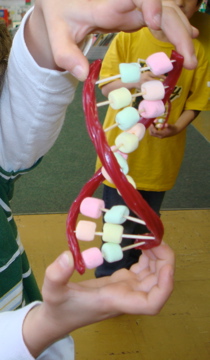
genomics for 1st graders

A week from tomorrow I face my daughter’s grade 1 class to talk about my job so if anyone has any nifty ideas for communicating DNA to 6 year olds I am all ears.  I have used the IKEA parts-list analogy for other lay audiences, and one of my coworkers who works in public education has forwarded some kick-ass ideas, but if anyone else happens along this post with some ideas I would be grateful.  My wife thinks I’m going to bomb.