Jetlag

I can never sleep on flights &  Sean O’Mahony has a post up about jetlag that’s pretty useful. He’s a veteran of overseas and local air travel, Europe, N America, Australia, and Asia, so I would take his views seriously.  I like that he distinguishes between eastward and westward travel, each of which hit me in different ways (east by far the worst).

Going East: On the flight eat the vegetarian food and avoid alcohol.
You should avoid coffee as well. It’s pretty easy on most flights as
it’s absolute crap anyway. If you arrive around lunchtime and if your
schedule allows then take a short nap between 4pm and 6pm. This is the
most important part. Under no circumstances let yourself sleep through.
If you do you are toast for the next 4-5 days. Get up after 90 minutes
or so and have a shower then leave the hotel and go and have dinner.
Back to the room, cup of herb tea some melatonin
and you’ll get 6 hours of good sleep. From here it’s a matter of
getting through your days and progressively going to bed later and
later but go to bed no earlier than 8pm.

That 4-6 nap is far too risky for me. I need to stay on my feet until 8 or 9 or else I zombify.  If the hotel has a pool I try to throw myself in, at least for a couple of laps, to fend off the moving floor feeling.  Not tried melatonin but I can second the advice about no alcohol and vegetarian meal. The tendency of the overseas flights to stuff you silly is deadly.   
Myristica fragrans

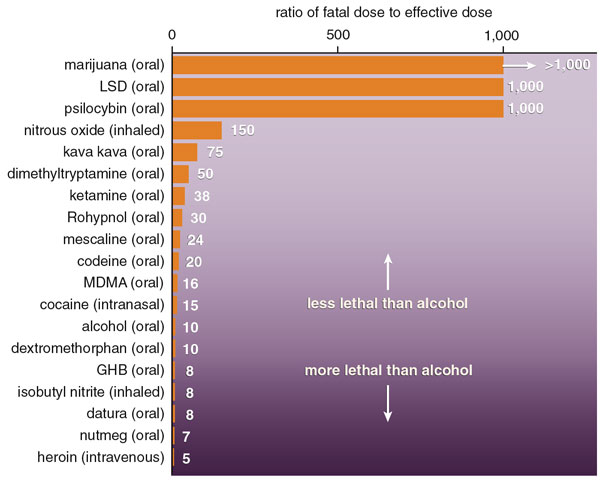
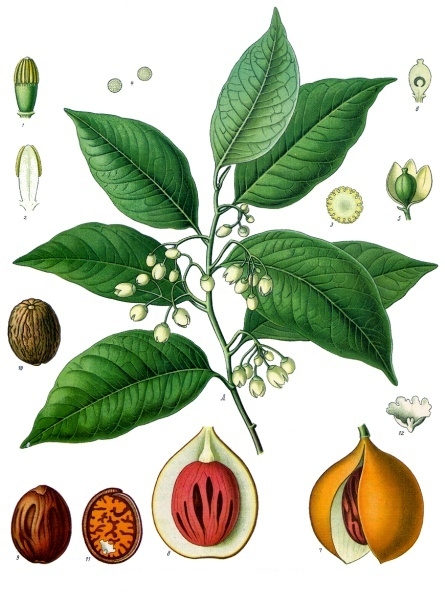
Koeh097At first pass the article on drug toxicity below was interesting for documenting (unsurprisingly) how toxic alcohol is and marijuana isn’t. However, glancing again at the figure I was mildly gobsmacked to notice that nutmeg is second only to heroin in lethality.  Nutmeg is interesting for a lot of reasons, mainly historical, and I knew it is reputed to have some medicinal use (though I am skeptical), but I had no idea it’s a potentially lethal hallucinogen. 

From Wikipedia:

In low doses, nutmeg produces no noticeable physiological or
neurological response. Large doses of 30 g or more are dangerous,
potentially inducing convulsions, palpitations, nausea, eventual dehydration,
and generalized body pain. In amounts of 5–20 g it is a mild to medium
hallucinogen, producing visual distortions and a mild euphoria. It is a
common m
isconception that nutmeg contains monoamine oxidase inhibitors (MAOIs). This is untrue; nutmeg should not be taken in combination with MAOIs but it does not contain them [2].
A test was carried out on the substance which showed that, when
ingested in large amounts, nutmeg takes on a similar chemical make-up
to MDMA
(ecstasy). However, use of nutmeg as a recreational drug is unpopular
due to its unpleasant taste and its side effects, including dizziness,
flushes, dry mouth, accelerated heartbeat, temporary constipation,
difficulty in
urination, nausea, and panic. A user will not experience
a peak until approximately six hours after ingestion, and effects can
linger for up to three d
ays afterwards. Any unpleasant side-effects
would persist throughout this period.[citation needed]

A risk in any large-quantity (over 25 g) ingestion of nutmeg is the onset of ‘nutmeg poisoning’, an acute psychiatric disorder marked by thought disorder, a sense of impending death, and agitation. Some cases have resulted in hospitalization.[citation needed]

Sheeple

Researchers have developed human-sheep chimeras as an avenue to addressing the growing demand for organ transplants.  Suprisingly  (to me anyway) these researchers have actually been allowed to produce a live animal, rather than stop the work at the fetal stage. So my question is at what ratio do we begin to consider an animal like this to be ‘human’ – 50%? 80%? 100%?  Note that the DNA itself has not been mixed.  Individual cells are either human or sheep.

O, what a brave new world.

Link: Now scientists create a sheep that’s 15% human.

Scientists have created the world’s first human-sheep chimera – which has the body of a sheep and half-human organs.

The
sheep have 15 per cent human cells and 85 per cent animal cells – and
their evolution brings the prospect of animal organs being transplanted
into humans one step closer.

Professor Esmail Zanjani, of the
University of Nevada, has spent seven years and £5million perfecting
the technique, which involves injecting adult human cells into a
sheep’s foetus.

He has already created a sheep liver which has a large proportion of
human cells and eventually hopes to precisely match a sheep to a
transplant patient, using their own stem cells to create their own
flock of sheep.

Aside from the animal welfare issue, there are some real risks with this sort of research. In particular, a nasty virus could find itself in a new and permissive environment:

Dr Patrick Dixon,
an international lecturer on biological trends, warned: "Many silent
viruses could create a biological nightmare in humans. Mutant animal
viruses are a real threat, as we have seen with HIV."

Animal
rights activists fear that if the cells get mixed together, they could
end up with cellular fusion, creating a hybrid which would have the
features and characteristics of both man and sheep. But Prof Zanjani
said: "Transplanting the cells into foetal sheep at this early stage
does not result in fusion at all."

Transgenic Mosquito Resistant to Malaria

Malariamosquitobg
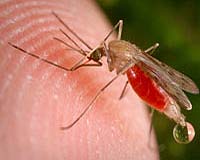
From Seed, scientists at John Hopkins have bred mosquitos that are resistant to malaria, and therefore unable to infect humans with the parasite. I haven’t read the original PNAS paper yet but I wonder what potential there is for the parasite to mutate around the resistance in the medium to long term i.e. how long before we return to square one.  Further into the article I hit the big qualifier:

The study suggested that when feeding on malaria-infected blood,
"transgenic malaria-resistant mosquitoes have a selective advantage
over non-transgenic mosquitoes," the authors wrote.

The lab-altered mosquitoes competed equally well with natural
insects when fed non-infected blood but did not outbreed their natural
counterparts in that case, according to the study.

For the strategy against malaria to be effective, transgenic
mosquitoes would have to outbreed the natural insects when feeding off
untainted blood.

Further research was still needed before the altered insects could
be released into the wild, as only a small percentage of mosquitoes in
nature are exposed to malaria, the authors wrote.

Still, the research carried "important implications for
implementation of malaria control by means of genetic modification of
mosquitoes," the authors wrote.

I am also curious what the regulatory process would be for releasing a transgenic insect into the wild.  I Guess it depends on where it is released.  For some countries it would be "Badges? We don’t need no stinking badges"

The Woman with a Breast on her Foot

Just a week or so ago I was speaking to a physician friend of mine who was telling me about patients with breast tissue growing at odd parts of their bodies.  I thought "huh, that’s weird, never heard of anything like that before".  I guess a breast always seemed to me such a complex organ that it couldn’t just randomly pop out just anywhere.  FootbreastAs if on cue, Pharyngula links to a paper about a woman with a breast on her foot:

A 22-year-old woman sought medical care for a lesion in the plantar
region of her left foot, a well-formed nipple surrounded by areola and
hair. Microscopic examination of the dermis showed hair follicles,
eccrine glands, and sebaceous glands. Fat tissue was noted at the base
of the lesion. Clinical and histopathologic findings were consistent
with the diagnosis of supernumerary breast tissue, also known as
pseudomamma. To our knowledge, this is the first report of
supernumerary breast tissue on the foot….Supernumerary nipples, and less frequently supernumerary breasts, are present in about 1-5 percent of the population [1].
Such alterations are more common in women, usually occurring along the
embryonic milk line, which extends from the axilla to the groin [1, 2].
Supernumerary breast tissue (SBT) is rarely found beyond the mammary line…

Putting aside the thought of how strange it must be to walk on that thing, I wonder if, as PZ Myers suggests, it would be relatively easy to grow a breast in vitro, and does this have implications for reconstructing breasts post-mastectomy.

the difference between a condom and a balloon

A few weeks ago my six year old daughter attended a presentation on sexual health at her school, put on by Saleema Noon.  Yesterday the presentation paid its first dividend.  My daughter and her friends found a used condom in the schoolyard.  Recognizing what it was, they called a teacher who had it removed. While waiting for the teacher, another kid picked up the condom and insisted it was a balloon, against the protests of his classmates, and proceeded to play with it.  Trust me when I say I am grateful my six year old sees a condom to avoid, rather than a balloon to play with.  Early education in sexual health is a good thing.

And they think so in Bali too:

Balinese teenagers, said the Doctor, preferred to have information and
advice about sex to come from their teachers, rather than their
parents, not surprisingly, and so Murjana urged that sex education be
adopted as part of the national school curriculum, and not only taught
in the biology classes of the science stream (IPA) at senior high
school as at present. Such education should begin at junior high
school, he added.


Cracking the code – Genomic medicine is poised to improve therapies, diagnosis & prevention

An article about the importance of genomics to the future of medicine, in the Mayo Clinic Connection:

The term "genomics" refers to the study of genes and their function. The term "genome" refers to all the genetic information each of us has in our body.

The reason medical scientists are excited about genomics is that it opens new possibilities for designing more effective and safer treatments for many diseases. Mayo Clinic is among the leading medical centers worldwide in developing new genomic therapies through its newly opened Mayo Clinic Genomics Research Center. (opens in new window) 

Mayo Clinic physicians anticipate a day — not too far in the future — when physicians can look at a person’s genetic code and determine at a molecular level who’s at risk of disease, how aggressive that disease    will be, and which course of treatment will be best to treat the disease without harmful side effects.


The Dengue Collaboration

Link: Blueprint Asia Announces Collaboration with the Novartis Institute for Tropical Diseases.:

The Blueprint Initiative Asia Pte. Ltd. (Blueprint Asia), housed at the National
University of Singapore, announced today that it is collaborating with the Novartis Institute for Tropical Diseases
(NITD) to further the company’s research into dengue fever, a debilitating infectious disease.

Blueprint Asia will assemble and curate known protein interactions relevant to the biology of the dengue virus, and will
enter this data into the Biomolecular Interaction Network Database (BIND).  BIND is a repository of biological data ranging
from molecular interactions and small-molecule chemical reactions to interfaces from three-dimensional structures, pathways
and genetics interaction networks…

"Our collaboration with NITD is consistent with Blueprint Asia’s goal
of facilitating research and drug discovery related to neglected
diseases that burden the Asia-Pacific region," says Dr. Christopher
Hogue, project leader and principal investigator of The Blueprint
Initiative…

Dengue fever is a mosquito-borne viral infection that causes fever and severe joint pain and, in more severe cases, can lead
to hemorrhage, shock and ultimately death.  Prevalent in tropical and sub-tropical regions, the disease affects 50 million
people across five continents, and infection rates are increasing dramatically.  A large proportion of the estimated 500,000
cases that require hospitalization each year are children.

Presently, there is no known cure or vaccine for this disease.  In fact, vaccine and chemotherapeutic development are
complicated by the need to develop therapies that protect against all four strains of dengue viruses, rather than just one.

"By examining information about dengue virus alongside other data in the BIND repository, NITD scientists will gain a better
understanding of the dengue life cycle and of complex interactions with host proteins leading to Dengue Hemorrhagic Fever,"
says Mr. Brian Yates, Managing Director of Blueprint Asia. "This information can then be used to develop drugs or vaccines
to fight the disease."

The collaboration is also expected to help NITD researchers identify gaps in their information base, which could lead to the
exploration of new avenues of research.