a new salmon genomics project

Genome British Columbia :: Salmon health: past, present and future.

Genome British Columbia, the Pacific Salmon Foundation and Fisheries and Oceans Canada are embarking on a remarkable partnership to discover the microbes present in salmon in BC that may be undermining the productivity of BC’s Pacific salmon. The project will conduct epidemiological assessments to explore the transmission dynamics and historical presence of detected microbes, with key focus on microbes that are suspected globally to be causing disease in salmon. Researchers will apply genomic technology to identify and verify which microbes are presently carried by BC’s wild and cultured fish.

The project is being managed in four sequential Phases with Phase 1 valued at $930,000. The first phase is taking place over 12 months, concluding mid-2013, and comprises the collection phase of both cultured and wild salmon. While later phases are subject to final funding, Phase 2 involves rigorous analysis of the tissue samples collected in Phase 1 and in previous research. Using molecular and genomic tools, the research team will attempt to determine when and where microbes may have been transmitted.  The research results will begin to rank microbes by their potential to cause disease in BC salmon based on relationships with microbes associated with disease in other parts of the world and histological evidence from salmon in BC.  Phase 3 will focus in on the microbes identified in Phase 2, with an emphasis on microbes that have not been extensively researched and that are thought to be of pathological significance in salmon. Phase 4 will include reporting of research and presentations to management agencies on the potential utility of methods developed and the application of outcomes to future monitoring.
Continue reading

Study Examines How Diving Marine Mammals Manage Decompression

"Until recently the dogma was that marine mammals have anatomical and physiological and behavioral adaptations to make the bends not a problem," said MMC Director Michael Moore. "There is no evidence that marine mammals get the bends routinely, but a look at the most recent studies suggest that they are actively avoiding rather than simply not having issues with decompression."

Researchers began to question the conventional wisdom after examining beaked whales that had stranded on the Canary Islands in 2002. A necropsy of those animals turned up evidence of damage from gas bubbles. The animals had stranded after exposure to sonar from nearby naval exercises. This led scientists to think that diving marine mammals might deal with the presence of nitrogen bubbles more frequently than previously thought, and that the animals' response strategies might involve physiological trade-offs depending on situational variables. In other words, the animals likely manage their nitrogen load and probably have greater variation in their blood nitrogen levels than previously believed.

Because the animals spend so much time below the ocean's surface, understanding the behavior of diving marine mammals is quite challenging. The use of innovative technology is helping to advance the science. At WHOI, scientists have used a CT scanner to examine marine mammal cadavers at different pressures to better understand the behavior of gases in the lungs and "get some idea at what depth the anatomy is shut off from further pressure-kinetics issues," Moore said. For other studies, Moore and his colleagues were able to acquire a portable veterinary ultrasound unit to look at the presence or absence of gas in live, stranded dolphins.

There's still a lot to be learned, including whether live animals have circulating bubbles in their systems that they are managing. If they do, says Moore, noise impacts and other stressors that push the animal from a normal management situation to an abnormal situation become more of a concern. "When a human diver has some bubble issues, what will they do? They will either climb into a recompression chamber so that they can recompress and then come back more slowly, or they'll just grab another tank and go back down for a while and . . . and just let things sort themselves out. What does a dolphin do normally when it's surfaced? The next things to do is to dive, and the one place you can't do that is in shallow water or most particularly if you are beached."

via www.sciencenewsline.com

Sunlight and bunker oil a fatal combination for Pacific herring

The 2007 Cosco Busan disaster, which spilled 54,000 gallons of oil into the San Francisco Bay, had an unexpectedly lethal impact on embryonic fish, devastating a commercially and ecologically important species for nearly two years, reports a new study by the University of California, Davis, and the National Oceanic and Atmospheric Administration.

The study, to be published the week of Dec. 26 in the early edition of the journal Proceedings of the National Academy of Sciences, suggests that even small oil spills can have a large impact on marine life, and that common chemical analyses of oil spills may be inadequate.

"Our research represents a change in the paradigm for oil spill research and detecting oil spill effects in an urbanized estuary," said Gary Cherr, director of the UC Davis Bodega Marine Laboratory and a study co-author.

Continue reading

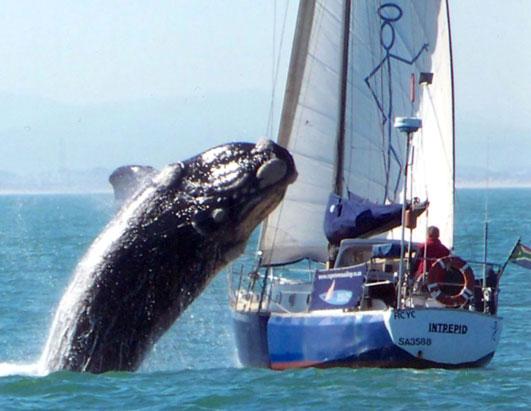
wow…whale 1 yacht 0

Ht_whale_onto_boat_100721_ssh
Paloma Werner said Wednesday the whale breached just feet (meters) from their boat in Cape Town's waters on Sunday. It whacked the yacht, snapping the mast in two. A local newspaper showed a photo, captured by a passenger on a nearby boat, of a massive black whale towering over the yacht. Werner says neither she nor her companion were hurt, and she saw the whale swimming around minutes after the collision.

via www.huffingtonpost.com