climate change is a hoax. cigarettes are good for you. what do scientists know?

Santa smoking

This paragraph in Leshner's op ed:

In April, 1994 — long after scientists had clearly demonstrated the
addictive quality and devastating health impacts of cigarette smoking
— seven chief executives of major tobacco companies denied the
evidence, swearing under oath that nicotine was not addictive.

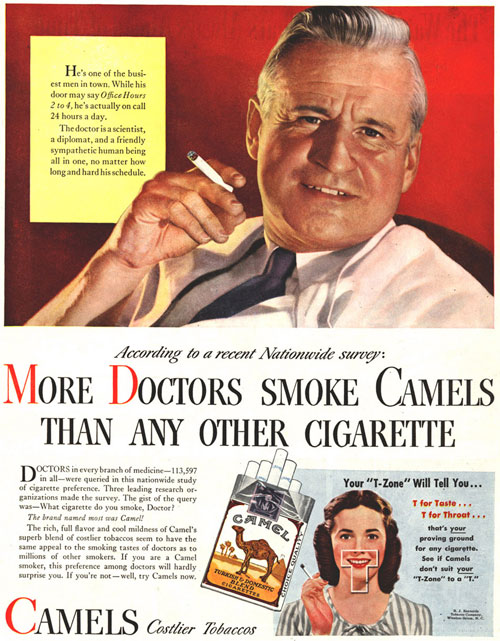
reminded me of growing up in the 70's, while the long battle over the health effects of smoking was still under way, with the cigarette companies denying links between smoking and cancer, or the addictive effects of cigs on young people, and the earlier ad campaigns to combat the mounting evidence turned science against itself.

Doctor smoking
Smoking is good

the scandal that isn’t

I am not sure what is supposed to be so shocking about the so-called "climategate" scandal.  Someone hacked into servers at the Climate Research Unit at East Anglia University.  Cue the flying monkeys of climate change denial who, after picking through the 10 years' worth of faculty emails, have declared climate change science invalidated.  Climate scientists can hang up their models and go home. It's all a big hoax! 

I challenge any organization, or individual for that matter, to surrender all of their email to their worst enemies.  Let's see what might turn up.  We might find that "gasp" some emails are nasty, inconsistent, dishonest, or just plain wrong.  Shock. horror. yawn.

This is typical behaviour of the denialist community (climate change, evolution, holocaust, birthers, etc.).  Launch fact-free attacks on the science and scientists, howl over reasonable scientific disputes, misrepresent uncertainty, argue in bad faith, quote mine and clip out of context, and generally behave like 4th graders. 

For some other views, let's check in with the lefty hippie treehuggers at Shell Oil (commenting at LGF):

I think that the science now tells us more than enough to warrant
action. Certainly there remain uncertainties, but not on the issue as a
whole.


With regards the private e-mails posted on the internet, I think the
story is a simple one and it could apply to any one of us. Think of all
the e-mails you have written over the past 10 years. Now imagine that
someone ciminally breaks into your e-mail account and downloads all of
them, handpicks a few and posts them on the internet to cast you in a
particular light. We could all be shown to be saints or sinners or
anything in between.


Now look at what has happened with these scientists going about their
work in much the same way anyone of us might attend to our job. Enough
said.

Enough indeed. Unfortunately some don't concur, and we'll be hearing more from the denialists & their monkeys.  Some further excellent roundup of the "controversy" at Nature, Popular Mechanics, and of course RealClimate.

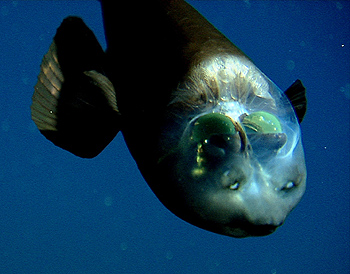
Macropinna microstoma

Saw this over at Deep Thoughts.  A beautifully weird fish, the "barreleye", with upward pointing eyes under a transparent canopy of a skull.  Another quirky player in life's mad pageant. This release from the Monterey Bay Aquarium Research Institute describes how researchers have discovered that these eyes can rotate to fix on prey (it was previously thought the eyes were fixed in their "barrels"), and that it might specialize in feeding on organisms trapped in jellyfish tentacles. The two duct-like bits above the mouth are nostrils.   
Another photo,Barreleye2-350 and a link to the paper in Copeia.

Einstein

I just finished a wonderful biography of Albert Einstein. Well crafted and striking a happy balance between personal life and his understanding of the universe.  A number of random thoughts:Einstein

  • His major contributions were generally behind him by 1920. The theory of relativity was published in 1905. 
  • He didn't fail math.
  • A rebel and a non-conformist, he struggled to find work in academic physics until he revolutionized it.
  • Some casual conversations with a friend and a letter to Roosevelt, and the US was in the atomic bomb business.
  • Had Hitler not lost his theoretical physicists, we'd all be speaking German.
  • The Schrodinger Cat thought experiment was an approach to challenging quantum mechanics, not demonstrating it.
  • He was an A-list celebrity. Will we ever again pour such fame on a scientist? Particularly for a discovery of no practical application (at least for the next 3 decades).
  • He was the archetype absent minded scientist.
  • He was a weakly observant Jew who was offered the presidency of Israel, and turned it down.
  • He liked to sail.
  • Friendly and gentle, he was a world government pacifist.
  • His theories as described in the book are accesible and understandable, and his use of thought experiments is well described. The treatment of quantum mechanics and Einstein's rejection of 'spooky action at a distance' are satisfyingly clear.

My only regret is that I progressed through it in in fits and starts.  It's a great read.

Nice work if you can get it

I’ve often been curious about the business of contributing scientific expertise to movies and television – how one gets the work, do they listen, that sort of thing.  In "My life as an advisor to TV and film", Wayne Grody describes his work for the Nutty Professor and CSI, among others.

For both Eddie Murphy Nutty Professor movies, the studio’s Art
Department asked me for assistance in designing the set for Professor
Klump’s laboratory. They came to my research lab at UCLA and took lots
of pictures, then we sat down with the Fisher products catalog and
started on page one as I pointed out what they needed to order as
"props" (with a budget of $50 million, money was no object)
….Sometimes my advice goes unheeded. Klump was supposed to be a
biology professor at a small liberal arts college, but his laboratory
occupied an entire soundstage on the Universal Studios lot — about ten
times larger than the best-funded faculty member at a major research
university. And while we tried to make it look as much like a
real-world molecular biology lab as possible (I brought my graduate
students along with me to help "dress the set"), when the director
arrived for the first scene to be shot there, he ordered some of the
visually boring thermal cyclers and centrifuges replaced by flasks and
tubes of bubbling green and purple liquids — more reminiscent of Dr.
Frankenstein’s laboratory than a modern facility….
…Even on the dramas, however, a cherished scientific truth will
sometimes have to be discarded in order to enable an essential story
development, such as a normally three-week-long forensic DNA analysis
that’s fictionally done in one hour for the sake of plot pacing. In
truth, few will ever notice these gaffs. As one TV producer told me,
the number of Ph.D. scientists watching his show accounts for no more
than 0.00001% of the Nielsen rating audience.

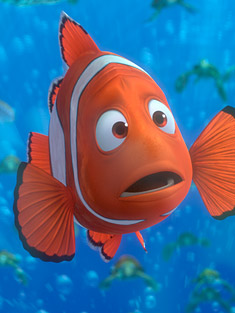
The bit about thumbing through a Fisher catalogue and budgets reminded me of a colleague ranting over beers about how the resources devoted to CGI on Finding Nemo Tale_leftdwarfed but at least one order of magnitude most large scale bioinfomatics efforts.  I think of a big project as something north of $5 million. But that’s just walking around money for the film industry.


cheaper to sequence his genome

25 Greatest Science Books of All-Time

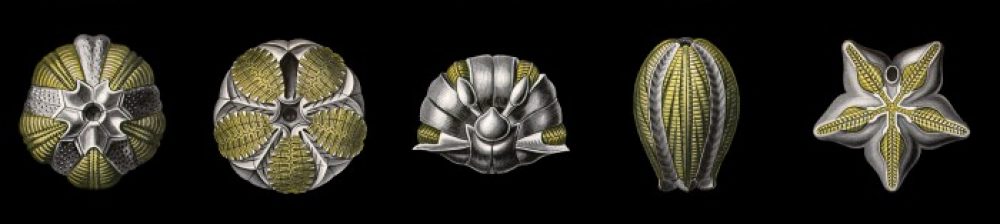
Discover magazine posts their list of the 25 Greatest Science Books of All-Time.  Happily Darwin takes the top 2 positions, with Newton’s Principia coming third. Which was a bit of a surprise to me.  I would have bet on Newton over Darwin for #1, and the inclusion of Beagle on the list at all would have seemed a long shot.  I have a lot of reading to do.  von Humbolt’s Cosmos should be there, as should Wallace’s The Malay Archipelago.  Also, Systema Naturae by Linnaeus, whose system of species classification still frames modern biology.

notes from the singularity

"Two billion years ago, our ancestors were microbes; a half-billion years ago, fish; a hundred million years ago, something like mice; ten million years ago, arboreal apes; and a million years ago, proto-humans puzzling out the taming of fire. Our evolutionary lineage is marked by mastery of change. In our time, the pace is quickening" – Carl Sagan, quoted in The Singularity is Near.

Kurzweil, in his chapter on technology evolution:
"evolution created humans, humans created technology, humans are now working with increasingly advanced technology to create new generations of technology. By the time of the Singularity, there won't be a distinction between humans and technology. This is not because humans will have become what we think of as machines today, but rather machines will have progressed to be like humans and beyond. Technology will be the metaphorical opposable thumb that enables our next step in evolution."

I don't usually go in for futurist writing. The predictions usually land wide of the mark and are no better than what you would hear at your local pub. In contrast, I am finding Kurweil's arguments (though I am just getting into the book) compelling, particularly as they dovetail with the leaping and bounding progress we're seeing in genomics & biotechnology. What I haven't seen yet is a convincing argument for his assumption of human/technology integration, rather than our technological creations simply leaving us behind, and pushing us from our niche, as the Neaderthals were pushed, by us.