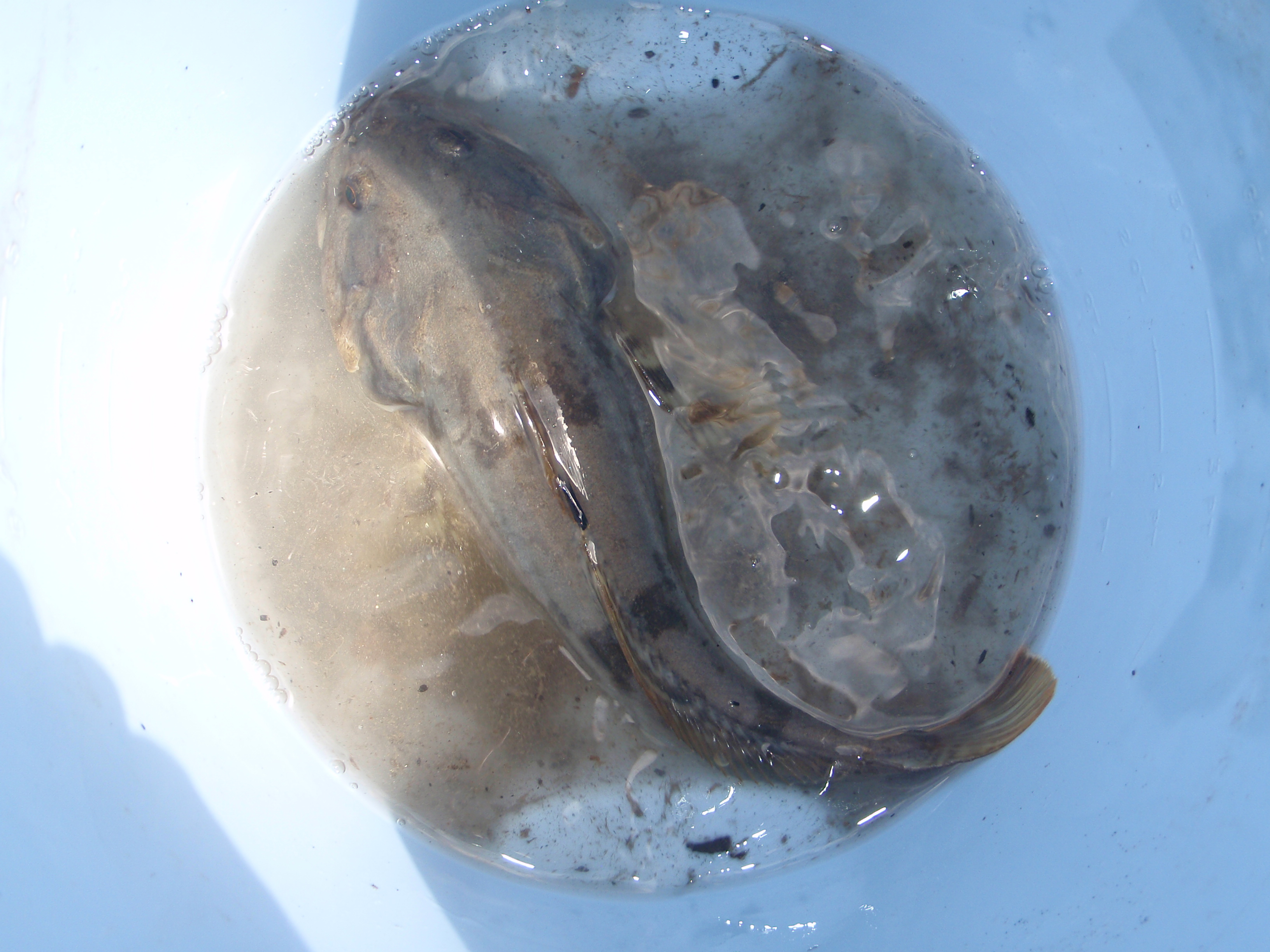
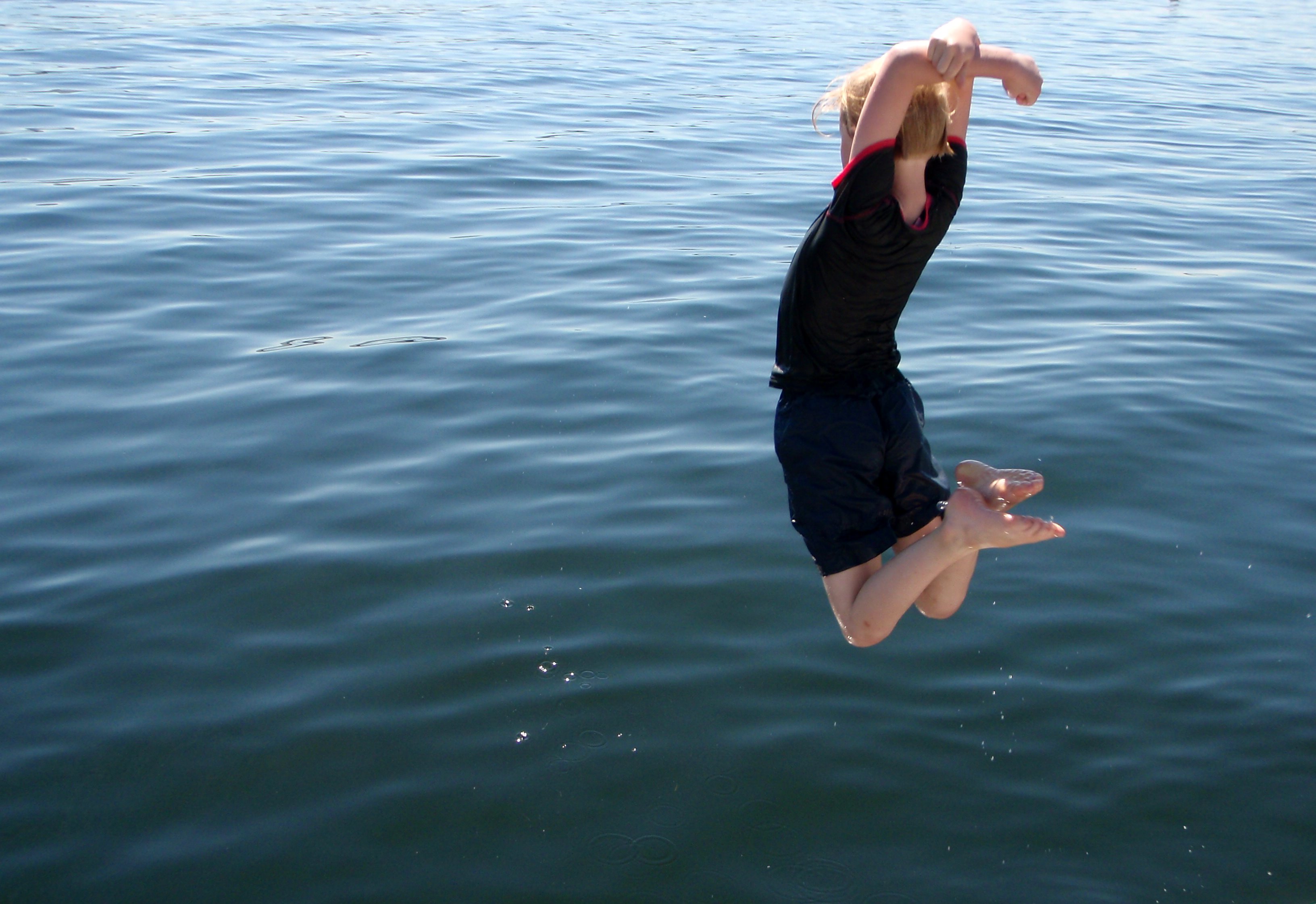
A couple of weekends ago the bairns and I participated in the Bullhead Derby in Steveston. Scores of kids chasing sculpins large and small off the shore of Garry Point. It was a lot of fun and #2 child took 2nd prize with a 9 1/2" fish (at right). All good.
Category Archives: underwater
World Oceans Day
Is today. Lots of relevant links at Blogfish's Carnival of the Blue. Also there is DFO's page, the Suzuki Foundation, and the Vancouver Aquarium (who are celebrating the week).
Get wet.
Orcinus orca
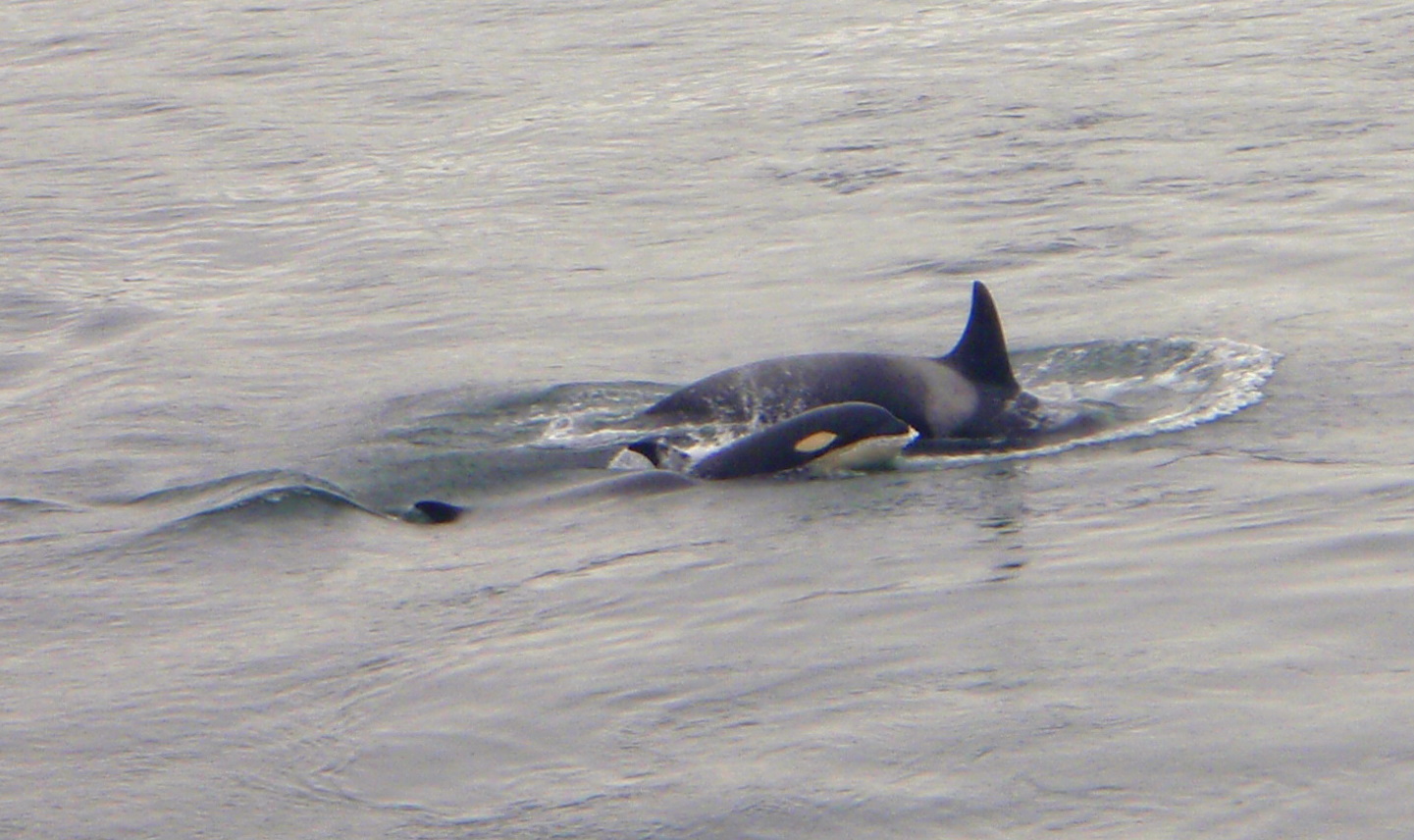
Last weekend while waiting for our ferry to cast off from Swartz Bay, Sidney, BC, a pod of resident killer whales passed within 100 m of us. In all the excitement we managed only one decent photo, a female and her offspring, likely chasing dinner in the harbour.
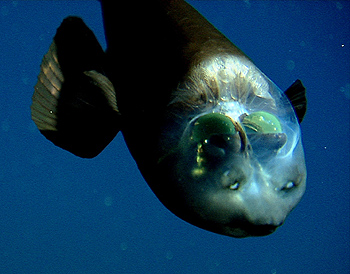
Macropinna microstoma
Saw this over at Deep Thoughts. A beautifully weird fish, the "barreleye", with upward pointing eyes under a transparent canopy of a skull. Another quirky player in life's mad pageant. This release from the Monterey Bay Aquarium Research Institute describes how researchers have discovered that these eyes can rotate to fix on prey (it was previously thought the eyes were fixed in their "barrels"), and that it might specialize in feeding on organisms trapped in jellyfish tentacles. The two duct-like bits above the mouth are nostrils.
Another photo,
and a link to the paper in Copeia.
Blue Biotechnology

My cGRASP blurb in the European Life Sciences Journal:
Canada and many other nations worldwide, particularly for coastal, rural and Aboriginal communities. T
he Consortium for Genomic Research on All Salmonids Project (cGRASP) integrates salmonid programmes in four nations – Canada, Norway, USA and the UK – into a unified research effort to develop critical genomics resources and tools that will further our understanding of salmonids, and support research in the areas of aquaculture, wild stock management and environmental protection.Still with us
Leafy Sea Dragon
Actually there are 2 Phycodurus eques in the picture. Photographed last January at the Birch Aquarium at Scripps. Sorry for the poor quality image but I have not got the knack of taking pictures through glass. I heartily recommend visiting the aquarium if you are in the La Jolla area. The Sea of Genes exhibit was very well done.
Great news, if true
Link: Rare Dolphin Seen in China, Experts Say – New York Times.
A Chinese man has videotaped a large white animal swimming in the Yangtze River that experts say is a member of a dolphin species unique to China and feared extinct, the official Xinhua news agency said Wednesday.
The last confirmed sighting of a member of the species, the long-beaked, nearly blind baiji, was in 2004. After an international team failed to find a single dolphin on a six-week expedition along the Yangtze last year, the species was classified as critically endangered and possibly extinct. But the videotape from central Anhui Province may renew slim hopes for the survival of the creature, also known as the white-flag dolphin.
19th-century weapon found in whale
This story hits me at a number of levels. I had no idea whales lived so long. General unhappiness at the professed need to kill these complex and intelligent animals. Hounded for a century – we finally got ‘im.
Link: 19th-century weapon found in whale – Yahoo! News.
A 50-ton bowhead whale caught off the Alaskan coast last month had a
weapon fragment embedded in its neck that showed it survived a similar
hunt — more than a century ago.Embedded deep under its blubber was a 3 1/2-inch arrow-shaped
projectile that has given researchers insight into the whale’s age,
estimated between 115 and 130 years old."No other finding has been this precise," said John Bockstoce, an adjunct curator of the New Bedford Whaling Museum.
Calculating a whale’s age can be difficult, and is usually gauged by
amino acids in the eye lenses. It’s rare to find one that has lived
more than a century, but experts say the oldest were close to 200 years
old.The bomb lance fragment, lodged a bone between the whale’s neck and
shoulder blade, was likely manufactured in New Bedford, on the
southeast coast of Massachusetts, a major whaling center at that time,
Bockstoce said.It was probably shot at the whale from a heavy shoulder gun around
1890. The small metal cylinder was filled with explosives fitted with a
time-delay fuse so it would explode seconds after it was shot into the
whale. The bomb lance was meant to kill the whale immediately and
prevent it from escaping.The device exploded and probably injured the whale, Bockstoce said.
"It probably hurt the whale, or annoyed him, but it hit him in a
non-lethal place," he said. "He couldn’t have been that bothered if he
lived for another 100 years."