AI composed Christmas song
H.A.P.P.Y.C.H.R.I.S.T.M.A.S
Reply

AI composed Christmas song
I’ve become increasingly interested in the issue of Artificial Intelligence as threat. No less than Elon Musk and Stephen Hawking have suggested that the creation of conscious AI will be an extinction event for humanity. If so, then why aren’t more people talking about it? Have a look at this TED talk by Sam Harris.
 We were very good this year and Santa brought us a new toy. So much has been written about the iPad there is little original to say. it's a beautiful device, and introduces the next phase in our relationship with information. We don't type extensive documents at home – our home computing needs focus on access to the internet, scheduling, music, photos etc. All far better managed through a touch interface tablet. And some of the Apps are just wonderful – Starwalk, for one, is breathtaking. The lack of a USB port, precluding a direct connection with our camera, is a bit of a flaw. Nonetheless this is clearly a breakthrough machine, and I look forward to the next iterations.
Google enters a long term purchase agreement with an Iowa wind farm.
We just completed a substantial 20-year green Power Purchase Agreement that allows us to take responsibility for our footprint and foster true growth in the renewable energy sector. On July 30 we will begin purchasing the clean energy from 114 megawatts of wind generation at the NextEra Energy Resources Story County II facility in Iowa at a predetermined rate for 20 years. Incorporating such a large amount of wind power into our portfolio is tricky (read more about how the deal is structured), but this power is enough to supply several data centers.
I think enabling people to associate household activities with spikes in power consumption is a leap forward in behaviour modification, and changes in consumer choices. Watching the slow burn of lights in an unoccupied room would get a lot of people to the 'off' switch.
Yes.


Facebook de-friends Burger King:
Facebook disabled the fast-food chain's "Whopper Sacrifice" app this week, saying that it violated the site's privacy
policy by alerting users when they were de-friended. Under normal
circumstances, de-friending is a quiet, anonymous act; Facebook doesn’t
inform you if you've been dumped.
Interesting to see e-activities described in CO2, and to note that the benefits of 'paperless' transactions have balancing costs.
As mentioned later in the article, what the IT burn is displacing is key. My view is that through entertainment and social networking we are increasing the carbon footprint of our personal lives.
If your internet use is in place of more energy-intensive activities, such as
driving your car to the shops, that’s good. But if it is adding activities
and energy consumption that would not otherwise happen, that may pose
problems.
Newcombe cites Second Life and Twitter, a rapidly growing website whose 3m
users post millions of messages a month. Last week Stephen Fry, the TV
presenter, was posting “tweets” from New Zealand, imparting such vital
information as “Arrived in Queenstown. Hurrah. Full of bungy jumping and
‘activewear’ shops”, and “Honestly. NZ weather makes UK look stable and
clement”.
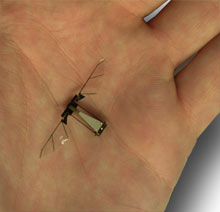
Researchers at Harvard have developed a robot that flies like a..fly. Using laser micro-machining techniques developed in house, and DARPA funding, the robo-fly was constructed from carbon fiber and polymer. This iteration is 60 mg with a wingspan of 3 cm and flies with a tether and external power – future versions are likely to be smaller, independent, and even more bug-like. This technology will be ideal for gathering information from targets on the move, or where access might be difficult i.e. trying to plant a traditional listening device. Once development costs come down and the technology improves, as it certainly will, one can imagine clouds of these things being released over hostile territory to engage in mobile, nearly invisible, real-time intelligence gathering. Pretty difficult, in an Afghan cave for instance, to discern the DoD fly from its biological comrades. They could be used to guide precision bombing as well, confirming targets on the fly, as it were.
Link: Technology Review: Robotic Insect Takes Off for the First Time:
By fitting many little carbon-polymer pieces together, the
researchers are able to create rather complicated parts that can bend
and rotate precisely as required. To make parts that will move in
response to electrical signals, the researchers incorporate
electroactive polymers, which change shape when exposed to voltage. The
entire fabrication process will be outlined in a paper appearing in an
upcoming edition of the Journal of Mechanical Design.After more than seven years of work studying flight dynamics and
improving various parts, Wood’s fly finally took off this spring. "When
I got the fly to take off, I was literally jumping up and down in the
lab," he says.Other researchers have built robots that mimic insects, but this is
the first two-winged robot built on such a small scale that can take
off using the same motions as a real fly. The dynamics of such flight
are very complicated and have been studied for years by researchers
such as Ron Fearing,
Wood’s former PhD advisor at the University of California, Berkeley.
Fearing, who is building his own robotic insects, says that he was very
impressed with the fact that Wood’s insect can fly: "It is certainly a
major breakthrough." But Fearing says that it is the first of many
challenges in building a practical fly……Tiny, lightweight sensors need to be integrated as well. Chemical
sensors could be used, for example, to detect toxic substances in
hazardous areas so that people can go into the area with the
appropriate safety gear. Wood and his colleagues will also need to
develop software routines for the fly so that it will be able to avoid
obstacles.
I’m with Sean , Facebook is an excellent application when you have an accumulation of friends in far flung corners of the earth and it’s too much to keep up with them via email. I’ve been hooked for a month now.
Since I’m on the subject of travel, I never really bought the line that cell phones were a safety issue. It didn’t make sense that the fields generated by the phones would be any worse than laptops or iPods. If they were dangerous, why are we allowed to carry them on while surrendering our nail clippers and shaving cream? Via Ezra Klein: Why cell phones are still grounded.
Phones are banned for two official reasons:
- Cell phones "might" interfere with the avionics (aviation electronics) of some airplanes.
- Cell phones aloft "might" cause problems with cell tower systems on the ground.
Both of these risks are easily tested, yet somehow neither the
Federal Aviation Administration (FAA) nor the Federal Communications
Commission has been able to get a definitive answer in the past 20
years as to whether phone calls in flight cause these suspected
problems. (The FAA is responsible for the flight safety portion of all
this, and the FCC is responsible for the cell tower part.)The government’s dirty little secret is that it cultivates
uncertainty about the effects of phones in airplanes as a way to
maintain the existing ban without having to confront the expense and
inconvenience to airlines and wireless carriers of allowing them.Why airlines want the ban
The airlines fear "crowd control" problems if cell phones are
allowed in flights. They believe cell phone calls might promote rude
behavior and conflict between passengers, which flight attendants would
have to deal with. The airlines also benefit in general from passengers
remaining ignorant about what’s happening on the ground during flights,
including personal problems, terrorist attacks, plane crashes and other
information that might upset passengers.One way to deal with callers bothering noncallers would be to
designate sections of each flight where calling is allowed — like a
"smoking section." But the ban is easier.
And this is just common sense:
Here’s another problem with the government’s abdication of responsibility on this question: Either phones and other gadgets can crash airplanes or they can’t. If they can, then we’ve got a serious problem on our hands, and airplanes need to be upgraded to protect the public safety.
What’s to stop terrorists from testing various gadgets, finding the ones with the highest levels of interferences, then turning on dozens of them at some crucial phase of flight, such as during a landing in bad weather?
If gadgets can’t crash planes, then the ban is costing billions of hours per year of lost productivity by business people who want to work in flight.
 iBiome