Christopher Hitchens is very ill

Adding gloom to a drizzled day, it appears Christopher Hitchens' cancer is very much worse than I had hoped. I've only just begun his autobiography and passed over the death of his father from the very same cancer. I'm finding it difficult to anticipate the loss of such a gifted thinker and writer.

In one way, I suppose, I have been “in denial” for some time, knowingly burning the candle at both ends and finding that it often gives a lovely light. But for precisely that reason, I can’t see myself smiting my brow with shock or hear myself whining about how it’s all so unfair: I have been taunting the Reaper into taking a free scythe in my direction and have now succumbed to something so predictable and banal that it bores even me. Rage would be beside the point for the same reason. Instead, I am badly oppressed by a gnawing sense of waste. I had real plans for my next decade and felt I’d worked hard enough to earn it. Will I really not live to see my children married? To watch the World Trade Center rise again? To read—if not indeed write—the obituaries of elderly villains like Henry Kissinger and Joseph Ratzinger? But I understand this sort of non-thinking for what it is: sentimentality and self-pity. Of course my book hit the best-seller list on the day that I received the grimmest of news bulletins, and for that matter the last flight I took as a healthy-feeling person (to a fine, big audience at the Chicago Book Fair) was the one that made me a million-miler on United Airlines, with a lifetime of free upgrades to look forward to. But irony is my business and I just can’t see any ironies here: would it be less poignant to get cancer on the day that my memoirs were remaindered as a box-office turkey, or that I was bounced from a coach-class flight and left on the tarmac? To the dumb question “Why me?” the cosmos barely bothers to return the reply: Why not?

via www.vanityfair.com

SPIEGEL Interview with Craig Venter: ‘We Have Learned Nothing from the Genome’

Via Pharyngula, a great interview with Craig Venter in Der Spiegel. I love his point about the limited value so far of the human genome to medicine. So far. It's yielded an immense amount for science and our understanding of evolution and human origins, biological diversity, etc. but still not a lot of clinical application.Also, I can highly recommend Venter's biography.  The guy's a visionary.

SPIEGEL: So the Human Genome Project has had very little medical benefits so far?

Venter: Close to zero to put it precisely.

SPIEGEL: Did it at least provide us with some new knowledge?

Venter: It certainly has. Eleven years ago, we didn't even know how many genes humans have. Many estimated that number at 100,000, and some went as high as 300,000. We made a lot of enemies when we claimed that there appeared to be considerably fewer — probably closer to the neighborhood of 40,000! And then we found out that there are only half as many. I was just in Stockholm for the 200th anniversary of the Karolinska Institute. The first presentation was about the many achievements the decoding of the genome has brought. Then I spoke and said that this century will be remembered for how little, and not how much, happened in this field.

SPIEGEL: Why is it taking so long for the results of genome research to be applied in medicine?

Venter: Because we have, in truth, learned nothing from the genome other than probabilities. How does a 1 or 3 percent increased risk for something translate into the clinic? It is useless information.

via www.spiegel.de

Update: Larry Moran left a comment pointing out that most informed scientists expected the human genome to contain 30,000 or fewer genes, and points to this post on his site: Facts and Myths Concerning the Historical Estimates of the Number of Genes in the Human Genome.  I also like this passage about the perceptions of our own complexity:

The second point will have to be put off for another time but it’s important enough to mention here. Ast thinks that humans need to make many times more proteins than worms and corn because we are so much more complex. There are two problems with such a point of view—are we, in fact, 2-3 times more complex than corn? And, does it take thousands of new proteins to generate the structures that make us unique?

I think some people exaggerate our complexity and the place of humans relative to other species. This incorrect perspective can cause some scientists to put their faith in weakly supported hypotheses that claim to explain why humans really are complex and important in spite of the fact that we don’t have a lot of genes.

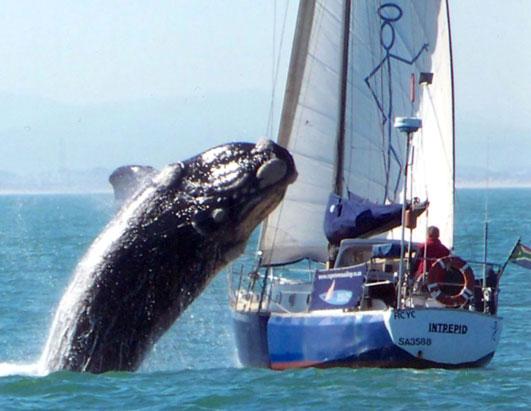
wow…whale 1 yacht 0

Ht_whale_onto_boat_100721_ssh
Paloma Werner said Wednesday the whale breached just feet (meters) from their boat in Cape Town's waters on Sunday. It whacked the yacht, snapping the mast in two. A local newspaper showed a photo, captured by a passenger on a nearby boat, of a massive black whale towering over the yacht. Werner says neither she nor her companion were hurt, and she saw the whale swimming around minutes after the collision.

via www.huffingtonpost.com

Reducing our carbon footprint with the direct purchase of renewable energy

Google enters a long term purchase agreement with an Iowa wind farm.

We just completed a substantial 20-year green Power Purchase Agreement that allows us to take responsibility for our footprint and foster true growth in the renewable energy sector. On July 30 we will begin purchasing the clean energy from 114 megawatts of wind generation at the NextEra Energy Resources Story County II facility in Iowa at a predetermined rate for 20 years. Incorporating such a large amount of wind power into our portfolio is tricky (read more about how the deal is structured), but this power is enough to supply several data centers.

via googleblog.blogspot.com

Vast ocean once covered Mars, say scientists | Science | The Guardian

Previous spacecraft investigations have pointed to the possible presence of an ancient ocean, with supporters for the idea that there is still a substantial amount of water under the surface as liquid or ice. Climate change over millions of years might have led to the disappearance of the atmosphere, which would mean that any water on the surface would boil away.

Volcanic activity is among other explanations for apparent gullies, river valleys, flood plains, lakes, seas and other signs of water that have vanished.

Gaetano Di Achille and Bryan Hynek, of the University of Colorado, led a team that analysed the distribution of supposed ancient delta deposits and river-valley networks on Mars. They found many of the deltas were at a similar elevation and suggested these might ring an ancient shoreline, providing strong support for a vast ocean once covering the northern plains of the planet.

via www.guardian.co.uk

If there was that much liquid water, there had to be life. When will we start finding real Martians?