Bolstering Bioinformatics Chops, Ontario Institute of Cancer Research Plans to Double Staff in Two Years

Ontario Institute of Cancer Research Plans to Double Staff in Two Years.

Augmenting its bioinformatics horsepower, OICR has added Francis Oulette, formerly director of UBC’s Bioinformatics Centre, and SAB member for Blueprint. as part of an overall increase in bioinformatics staff :

The Ontario Institute of Cancer Research
plans to nearly double its research staff over the next two years as it
gears up to create a bioinformatics infrastructure to accommodate
planned sequencing research, according to an institute official.
 
Last year, the Government of Ontario funneled the equivalent of
$350 million into the Toronto-based institute, which, having grown out
of the Ontario Cancer Research Network, aims to translate cancer
research into drugs and new technologies…

…That impact has attracted almost 40 others
since the institute opened last year. It currently employs 57 people,
according to Hudson, who said that number will grow to more than 100
over the next two years with slots filled for biology, epidemiology,
bioinformatics, and computer science.
 
So far, there are eight spots filled in the center’s Informatics
and BioComputing department, which Stein oversees. Six more have been
hired, including four sequencing technicians who start Aug. 27, Hudson
said.
 
The cancer center is set up to accommodate a 16-node cluster, with
tools provided by IBM, and has a 300-square-foot room set aside to
house its server, according to Hudson. He said the facility spent
around CA$1 million dollars on computer equipment.
Emergency in West Java

A State of Emergency is being called for in Bandung, West Java.  What disaster is plaguing Indonesia this time? Earthquake? Volcano? Tsunami? Flood? Terrorist attack? Avian flu?

Nope – worse.  Hookers!:

A State of Emergency needs to be declared in Bandung, because of prostitution.

The Bandung Sin Watch (Bandung Maksiat Watch (BMW)) association,
which is an umbrella organisation for a number of Islamic groups
including Majelis Mujahidin, Pemuda Muhammadiyah, and Tim Pengacara
Muslim, and is led by Asep Syarifudin of the Front Pembela Islam (see Headscarf Ban),
has called on the Bandung city government in West Java to declare a
Prostitution Emergency over the rampant practice of prostitution there.

Wonder if the Red Cross will get involved.
Link: Prostitution Emergency | Indonesia Matters.

The future of surveillance

Fly_robot
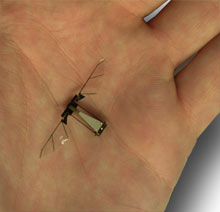
Researchers at Harvard have developed a robot that flies like a..fly.  Using laser micro-machining techniques developed in house, and DARPA funding, the robo-fly was constructed from carbon fiber and polymer.  This iteration is 60 mg with a wingspan of 3 cm and flies with a tether and external power – future versions are likely to be smaller, independent, and even more bug-like.  This technology will be ideal for gathering information from targets on the move, or where access might be difficult i.e. trying to plant a traditional listening device.  Once development costs come down and the technology improves, as it certainly will, one can imagine clouds of these things being released over hostile territory to engage in mobile, nearly invisible, real-time intelligence gathering.  Pretty difficult, in an Afghan cave for instance, to discern the DoD fly from its biological comrades.  They could be used to guide precision bombing as well, confirming targets on the fly, as it were.

Link: Technology Review: Robotic Insect Takes Off for the First Time:

By fitting many little carbon-polymer pieces together, the
researchers are able to create rather complicated parts that can bend
and rotate precisely as required. To make parts that will move in
response to electrical signals, the researchers incorporate
electroactive polymers, which change shape when exposed to voltage. The
entire fabrication process will be outlined in a paper appearing in an
upcoming edition of the Journal of Mechanical Design.

After more than seven years of work studying flight dynamics and
improving various parts, Wood’s fly finally took off this spring. "When
I got the fly to take off, I was literally jumping up and down in the
lab," he says.

Other researchers have built robots that mimic insects, but this is
the first two-winged robot built on such a small scale that can take
off using the same motions as a real fly. The dynamics of such flight
are very complicated and have been studied for years by researchers
such as Ron Fearing,
Wood’s former PhD advisor at the University of California, Berkeley.
Fearing, who is building his own robotic insects, says that he was very
impressed with the fact that Wood’s insect can fly: "It is certainly a
major breakthrough." But Fearing says that it is the first of many
challenges in building a practical fly…

…Tiny, lightweight sensors need to be integrated as well. Chemical
sensors could be used, for example, to detect toxic substances in
hazardous areas so that people can go into the area with the
appropriate safety gear. Wood and his colleagues will also need to
develop software routines for the fly so that it will be able to avoid
obstacles.

Newsflash! The world is getting better!

It rare to see such a powerful and accessible use of statistics.  In this video,  Hans Rosling traces the march of global health and wealth since the early 60’s.  There is lots of gold here – my favourite nugget is the tremendous progress made in Vietnam since the war, and generally the rise of Asia from poverty to middle income.  Also illuminating is the diversity within regions and countries in the developing world.  Watch it all.  Certainly underscores the link between the removal of trade barriers and the prosperity of poor nations.

http://video.ted.com/assets/player/swf/EmbedPlayer.swf

Creationist Terrorism?

Via Panda’s Thumb, labs and individuals at the University of Colorado have been threatened by a religious group of indeterminate flavour.  The Denver Post – Threats by religious group spark probe at CU-Boulder:

University of Colorado police are
investigating a series of threatening messages and documents e-mailed
to and slipped under the door of evolutionary biology labs on the
Boulder campus.

The messages included the name of a religious-themed
group and addressed the debate between evolution and creationism, CU
police Cmdr. Brad Wiesley said. Wiesley would not identify the group
named because police are still investigating.

"There were no overt threats to anybody specifically by
name," Wiesley said. "It basically said anybody who doesn’t believe in
our religious belief is wrong and should be taken care of."

Who wants to bet they’re not muslim?


“life” or something like it

On the heels of this announcement touting the promise of synthetic biology comes an editorial in Nature intended to dampen the inevitable sensationalism around the equally inevitable creation of an organism in the lab.  I really like the editors’ take on this as they highlight the lack of clear thresholds in nature, even between the living and nonliving.  Anyone interested in prions or viruses is familiar with the "alive or not" debate, and this editorial puts up the argument that we know exactly what ‘life’ is.

Link: Meanings of ‘life’ : Article : Nature.

There is a popular notion that life is something that appears when a clear threshold is crossed. One might have hoped that such perceptions of a need for a qualitative difference between inert and living matter — such vitalism — would have been interred alongside the pre-darwinian belief that organisms are generated spontaneously from decaying matter. Scientists who regard themselves as well beyond such beliefs nevertheless bolster them when they attempt to draw up criteria for what constitutes ‘life’. It would be a service to more than synthetic biology if we might now be permitted to dismiss the idea that life is a precise scientific concept….

…..Synthetic biology’s view of life as a molecular process lacking moral
thresholds at the level of the cell is a powerful one. And it can and
perhaps should be invoked to challenge characterizations of life that
are sometimes used to defend religious dogma about the embryo. If this
view undermines the notion that a ‘divine spark’ abruptly gives value
to a fertilized egg — recognizing as it does that the formation of a
new being is gradual, contingent and precarious — then the role of the
term ‘life’ in that debate might acquire the ambiguity that it has
always warranted.

What is life? I think Opus said it best, don’t you?

Exactly