a rare albino sea turtle, in a Sri Lankan sanctuary. easily spotted by predators, they typically don't last long in the wild
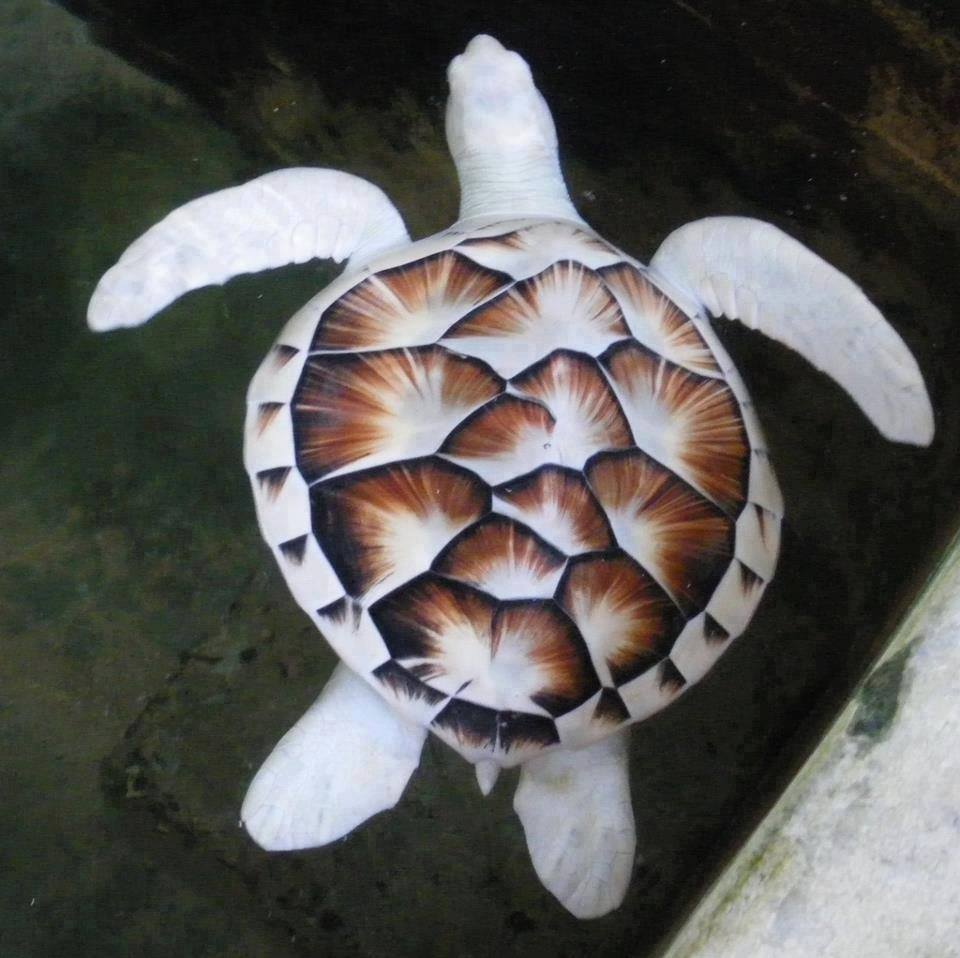
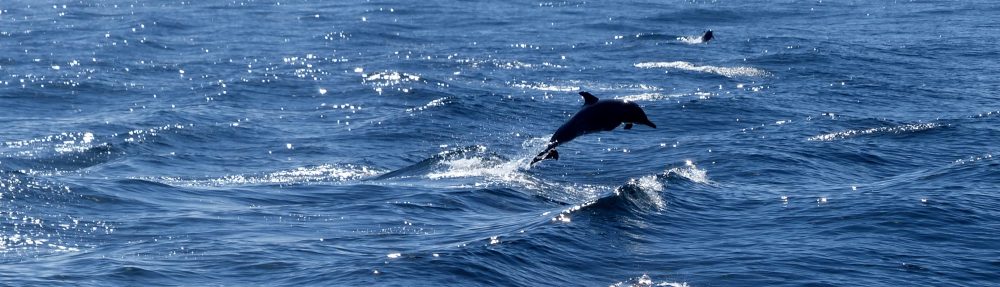
a rare albino sea turtle, in a Sri Lankan sanctuary. easily spotted by predators, they typically don't last long in the wild
not much time to think let alone blog these days, but this is pretty awesome:
The backstory:
In the summer of 1981, the British band Queen was recording tracks for their tenth studio album, Hot Space, at Mountain Studios in Montreux, Switzerland. As it happened, David Bowie had scheduled time at the same studio to record the title song for the movie Cat People. Before long, Bowie stopped by the Queen sessions and joined in. The original idea was that he would add backup vocals on the song “Cool Cat.” “David came in one night and we were playing other people’s songs for fun, just jamming,” says Queen drummer Roger Taylor in Mark Blake’s book Is This the Real Life?: The Untold Story of Freddie Mercury and Queen. “In the end, David said, ‘This is stupid, why don’t we just write one?’” And so began a marathon session of nearly 24-hours–fueled, according to Blake, by wine and cocaine. Built around John Deacon’s distinctive bass line, the song was mostly written by Mercury and Bowie. Blake describes the scene, beginning with the recollections of Queen’s guitarist:
‘We felt our way through a backing track all together as an ensemble,’ recalled Brian May. ‘When the backing track was done, David said, “Okay, let’s each of us go in the vocal booth and sing how we think the melody should go–just off the top of our heads–and we’ll compile a vocal out of that.” And that’s what we did.’ Some of these improvisations, including Mercury’s memorable introductory scatting vocal, would endure on the finished track. Bowie also insisted that he and Mercury shouldn’t hear what the other had sung, swapping verses blind, which helped give the song its cut-and-paste feel.
Genome British Columbia :: Salmon health: past, present and future.
Genome British Columbia, the Pacific Salmon Foundation and Fisheries and Oceans Canada are embarking on a remarkable partnership to discover the microbes present in salmon in BC that may be undermining the productivity of BC’s Pacific salmon. The project will conduct epidemiological assessments to explore the transmission dynamics and historical presence of detected microbes, with key focus on microbes that are suspected globally to be causing disease in salmon. Researchers will apply genomic technology to identify and verify which microbes are presently carried by BC’s wild and cultured fish.
The project is being managed in four sequential Phases with Phase 1 valued at $930,000. The first phase is taking place over 12 months, concluding mid-2013, and comprises the collection phase of both cultured and wild salmon. While later phases are subject to final funding, Phase 2 involves rigorous analysis of the tissue samples collected in Phase 1 and in previous research. Using molecular and genomic tools, the research team will attempt to determine when and where microbes may have been transmitted. The research results will begin to rank microbes by their potential to cause disease in BC salmon based on relationships with microbes associated with disease in other parts of the world and histological evidence from salmon in BC. Phase 3 will focus in on the microbes identified in Phase 2, with an emphasis on microbes that have not been extensively researched and that are thought to be of pathological significance in salmon. Phase 4 will include reporting of research and presentations to management agencies on the potential utility of methods developed and the application of outcomes to future monitoring.
"What this should hopefully do is result in a major upgrade in the quality of writing about Wallace," the historian told BBC News.
"Next year is the centenary of his death. Just like 2009 was the big Darwin year, 2013 will be the big Wallace year. And I hope now that people have access to all of his literature, it will make a big difference to what they say and write about him."
Wallace Online gathers together in one place for the first time all of the naturalist's writings and illustrations.
There are 28,000 pages of searchable documents and 22,000 images. Among the online gems is that first announcement of the theory of evolution delivered to a London scientific meeting 154 years ago.
It remains one of the great coincidences in scientific history that the one person Wallace should choose to approach to share his ideas on natural selection was the only other scientist who separately had come to the same conclusions – Charles Darwin.
via www.bbc.co.uk
the view from our pale blue dot…breathtaking

Source: Hubblesite.org
Because of the time it takes for light in the distant universe to reach Earth, when we look at, for example, a star a billion light-years away, we’re actually seeing what a portion of the cosmos looked like a billion years ago.
So, by combining pictures of various reaches of a small patch of sky, Hubble’s new eXtreme Deep Field (XDF) image, released Tuesday, essentially flattens time. Primitive, 13-billion-year-old galaxies—born just 450 million years after the big bang—seem to float side-by-side with closer, more advanced galaxies.
As “the deepest image of the sky ever obtained,” the XDF picture “reveals the faintest and most distant galaxies ever seen,” Hubble astronomer Garth Illingworth, of the University of California, Santa Cruz, said in a statement.
And some of the prettiest. “It’s beautiful,” said Geza Gyuk, director of astronomy at Chicago’s Adler Planetarium. “The level of detail is amazing, and being able to look that far back in time is incredible. You can begin to really see the vast majority of the history of the universe in a single image.”
Vancouver is at risk of losing landmark communities like Granville Island and False Creek unless the city starts taking measures to defend its shoreline against rising sea levels, an urban planner warns.
Andrew Yan, a planner and researcher with Bing Thom Architects, estimates the city will have to spend upwards of $510 million to build and upgrade the dikes and seawalls – plus billions more to buy the land to put them on – over the next century.
"What's under threat in Vancouver is a lot of our identity; our beaches, our seawall … this is what makes Vancouver such a livable place," Yan said. "We just need to look at Granville Island and its exposure to sea level rise and what may be required to defend it."
Vancouver isn't the only city under threat.
Richmond's Steveston, which has experienced huge residential growth along its waterfront in recent years, will face significant pressures in the future, Yan said, while south Surrey's Crescent Beach is already being threatened by a more insidious force: increasing groundwater from rising ocean tides.
"It affects every municipality that touches the water," Yan said. "Sea level rise isn't going to separate itself from the boundaries of Vancouver, Burnaby, Richmond or Surrey. We'd better be serious about this. It's important to plan now as opposed to 50 or 70 years from now."
……..
The report illustrated a number of sea level rise scenarios, from one to six metres, which could affect between three and 13 per cent of the city's land mass. For instance, sea level rise at the three-metre interval, combined with a severe storm in 2100, would affect most of the city's shoreline, including the harbour, the southern edge of the city and Granville Island.
And it gets worse: At the four-metre interval, False Creek would revert to its 19th-century boundaries, while Gastown, Chinatown and the harbour would be heavily affected. And at five-and six-metre intervals, the report warns, downtown Vancouver would become an archipelago and the city's coast-line would be "unrecognizable" compared to today's.
The relentless, weather-gone-crazy type of heat that has blistered the United States and other parts of the world in recent years is so rare that it can’t be anything but man-made global warming, says a new statistical analysis from a top government scientist.
The research by a man often called the “godfather of global warming” says that the likelihood of such temperatures occurring from the 1950s through the 1980s was rarer than 1 in 300. Now, the odds are closer to 1 in 10, according to the study by NASA scientist James Hansen. He says that statistically what’s happening is not random or normal, but pure and simple climate change.
“This is not some scientific theory. We are now experiencing scientific fact,” Hansen told The Associated Press in an interview.
Hansen is a scientist at NASA’s Goddard Institute for Space Studies in New York and a professor at Columbia University.
The Greenland ice sheet melted at a faster rate this month than at any other time in recorded history, with virtually the entire ice sheet showing signs of thaw.
The rapid melting over just four days was captured by three satellites. It has stunned and alarmed scientists, and deepened fears about the pace and future consequences of climate change.
In a statement posted on Nasa's website on Tuesday, scientists admitted the satellite data was so striking they thought at first there had to be a mistake.
"This was so extraordinary that at first I questioned the result: was this real or was it due to a data error?" Son Nghiem of Nasa's Jet Propulsion Laboratory in Pasadena said in the release.
well i finished the crimson serpent.  doc savage delivers hearty satisfying pulp fiction. written in the 30's, it's a view of the world excited by science, technology, and the broadening horizons of global exploration. recommended reading for anyone.
 iBiome