The Last Neanderthal’s Love Song

O ancestors! Please hear my cry.
I'm eighteen summers old.
I need a wife, but evolution's
Left me in the cold.

I'm the last Neanderthal.
I have some woman friends—
Nice-looking, others tell me—but
They're Homo sapiens.

I'd like to meet a girl like Mom
With a rich potato form.
These sapiens are willowy;
They don't look very warm.

A woman looks her best, I think,
With low, protruding brow,
But the female forehead fashion
Is high and flat right now.

A lady's lower jaw should sink
Delicately in.
Beneath their lips, these girls have got
A pointy, prickly "chin."

A sideways egg's the pretty shape
That suits a female skull.
But modern girls have heads as round
As the moon does when it's full.

Alas, O ancestors! Alas,
Our race will not survive.
I'll never wed, and I'm the last
Neanderthal alive.

via www.steamthing.com

found this over at the Dish. It begs to be set to an Arthur Sullivan score.

Reality check

via Sullivan, nothing like actual data to bust a myth.  As Seth Godin states, fear of the unknown overrides common perceptions of workaday risk:

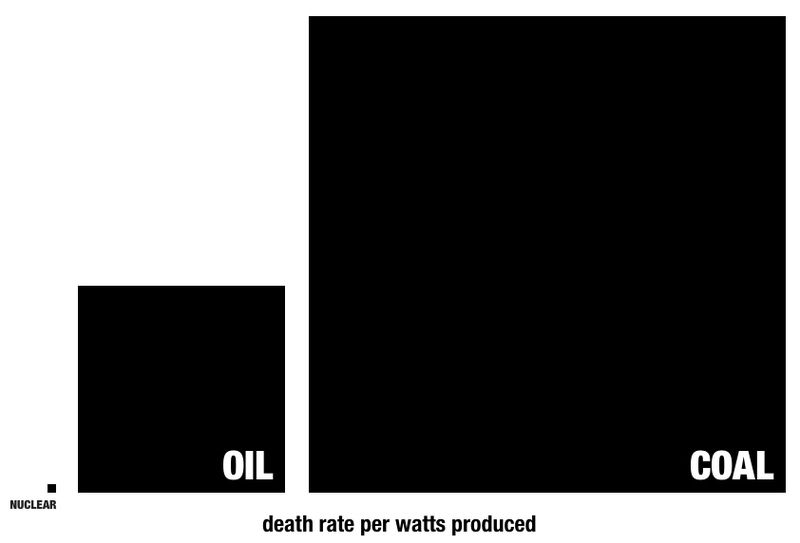
Nuclear coal oil
For every person killed by nuclear power generation, 4,000 die due to coal, adjusted for the same amount of power produced… You might very well have excellent reasons to argue for one form over another. Not the point of this post. The question is: did you know about this chart? How does it resonate with you?

Vivid is not the same as true. It's far easier to amplify sudden and horrible outcomes than it is to talk about the slow, grinding reality of day to day strife. That's just human nature. Not included in this chart are deaths due to global political instability involving oil fields, deaths from coastal flooding and deaths due to environmental impacts yet unmeasured, all of which skew it even more if you think about it.

This chart unsettles a lot of people, because there must be something wrong with it. Further proof of how easy it is to fear the unknown and accept what we've got.

via sethgodin.typepad.com

Nukes: Improve them, but don’t even think of abandoning them

It may be possible in Europe and North America to talk about reducing consumer demand for electricity and using alternatives instead of nukes. But none of that applies in Asia, Africa or South America, where the most pressing demand in the next two decades will be to turn three billion poor or impoverished people into energy consumers – ideally, high-efficiency, low-waste consumers, but certainly people able to have street lighting and refrigerators.

To do this without nuclear power would either be ecologically catastrophic, because it would rely on more coal-fired generation than the world has seen, or murderously inhumane, because it would raise energy prices to levels that would keep people in terrible poverty.

The world needs two things now: fewer carbon emissions, and a growing supply of energy at a low cost. By accomplishing both, nuclear power, even factoring in disasters, can save millions of lives.

Some leading environmentalists this week immediately recognized the danger of abandoning nuclear power. The British arch-Green activist George Monbiot wrote a cri de coeur on Thursday urging countries to stay with nuclear: “Even when nuclear power plants go horribly wrong, they do less damage to the planet and its people than coal-burning stations operating normally,” he wrote, rightly.

“Coal, the most carbon-dense of fossil fuels, is the primary driver of human-caused climate change. If its combustion is not curtailed, it could kill millions of times more people than nuclear power plants have done so far. … Abandoning nuclear power as an option narrows our choices just when we need to be thinking as broadly as possible.”

via www.theglobeandmail.com

We need nuclear power, and lots more of it, if we want to effectively curb climate change.

Soaring Food Prices. A result of climate change?

Krugman:

Overall grain production is down — and it’s down substantially more when you take account of a growing world population. Wheat production (this time not per capita) is way down.

You might ask why a production shortfall of 5 percent leads to a doubling of prices. Part of the answer is that some kinds of demand are growing faster than population — in particular, China is becoming a growing importer of feed to meet the demand for meat. But the main point is that the demand for grain is highly price-inelastic: it takes big price rises to induce people to consume less, yet collectively that’s what they must do given the shortfall in production.

Why is production down? Most of the decline in world wheat production, and about half of the total decline in grain production, has taken place in the former Soviet Union — mainly Russia, Ukraine, and Kazakhstan. And we know what that’s about: an incredible, unprecedented heat wave.

Obligatory disclaimer: no one event can be definitively assigned to climate change, just as you can’t necessarily claim that any one of the fender-benders taking place right now in central New Jersey was caused by the sheet of black ice currently coating our roads. But it sure looks like climate change is a major culprit.

via krugman.blogs.nytimes.com

The Pregnable Fortress

British Singapore took far less time to surrender than I took to finish this book.  At over 600 pages, much of it dumps of primary and secondary information, this felt like reading the appendices of a book that was missing, something that took me at a high level through the fall of Singapore before plunging into detail.  If ever I have missed forest for trees, it was reading The Pregnable Fortress.  At the risk of sounding overly negative, I think this would be a great second book to read about the fall, after getting sense of the overall narrative and context from another source.  

SINGAPORE The focus of most World War II writing, at least that I've been exposed to, has been the war in Europe, both western and eastern fronts, and secondarily the American effort in the Pacific after Pearl Harbor.  Until living in Singapore I had no sense of the importance Singapore had as an eastern bastion of the British Empire, and was widely viewed as "impregnable" (as the Titanic was viewed as unsinkable).  Expected to hold for weeks or months, in theory until the Royal Navy's Mediterranean fleet could be dispatched for relief, Singapore fell to the Japanese in 6 days.  In Churchill's words it was "the worst disaster and largest capitulation in British history".  Britain's stature in the Far East was permanently crippled. 

What I learned: While General Percival, Singapore's military commander, has been historically blamed for the surrender, the loss of Singapore arose from a blend of indifference and incompetence in London, including years of neglect by Churchill himself (manifested for example in a lack of adequate air cover), mass desertions by Australian and Indian troops, and petty infighting among senior British officials in Singapore and Malaya.   The British underestimated the Japanese almost to the end, and paid a rough price (though not I think as great a price as the Chinese population).

Unfortunately the Japanese were pushed too far into the periphery in the book – the dire situation with their supply lines and ammunition were presented almost as afterthought.  They were on the verge of ending the their advance when Percival capitulated, but little detail is presented on their situation or leadership.

A dense read, but worth it for a pacific war buff.
the future is iPad

IPadWe were very good this year and Santa brought us a new toy.  So much has been written about the iPad there is little original to say.  it's a beautiful device, and introduces the next phase in our relationship with information.  We don't type extensive documents at home – our home computing needs focus on access to the internet, scheduling, music, photos etc.  All far better managed through a touch interface tablet.  And some of the Apps are just wonderful – Starwalk, for one, is breathtaking.  The lack of a USB port, precluding a direct connection with our camera, is a bit of a flaw.  Nonetheless this is clearly a breakthrough machine, and I look forward to the next iterations.