Scientists Create World’s Largest Coral Gene Database

Promising findings from genomic analysis of corals:

Corals face four major threats from humans: Destruction of reefs by grenades and poison used to kill fish for food; nutrient pollution, usually from sewage or agricultural runoff, that overstimulates harmful algae; increased heat in the upper ocean, which causes most coral bleaching that can kill reefs; and acidification of the ocean, according to Falkowski.”Corals are the most diverse marine ecosystems on the planet,” he said. “But their value to marine ecosystems — and to our own use of marine resources — is very underappreciated.”

Perhaps the extreme diversity of coral systems help along an adaptive response to climate change:

Bhattacharya and coauthors found dozens of genes that allow corals to coordinate their response to changes in temperature, light and pH (acidity vs. alkalinity) and deal with stress triggered by the algae that live with them and exposure to high levels of light.
Surprisingly, some of these stress-related genes are of bacterial origin and were acquired to help corals survive. An intriguing theory that arose from the study is that the vast genetic repertoire of corals may help them adapt to changing ocean conditions.

Source: Scientists Create World’s Largest Coral Gene Database
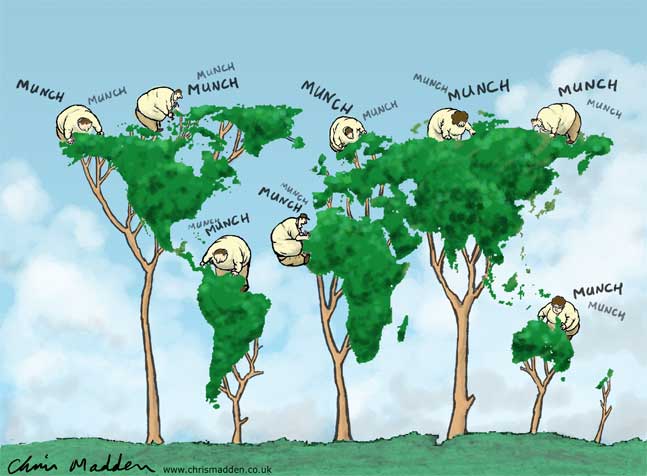
the end is nigh

Energy-related carbon-dioxide (CO2) emissions in 2010 were the highest in history, according to the latest estimates by the International Energy Agency (IEA).

After a dip in 2009 caused by the global financial crisis, emissions are estimated to have climbed to a record 30.6 Gigatonnes (Gt), a 5% jump from the previous record year in 2008, when levels reached 29.3 Gt.

In addition, the IEA has estimated that 80% of projected emissions from the power sector in 2020 are already locked in, as they will come from power plants that are currently in place or under construction today.

“This significant increase in CO2 emissions and the locking in of future emissions due to infrastructure investments represent a serious setback to our hopes of limiting the global rise in temperature to no more than 2ºC,” said Dr Fatih Birol, Chief Economist at the IEA who oversees the annual World Energy Outlook, the Agency’s flagship publication.

via www.iea.org

People being who we are, I suspect it will take extended, soaring food prices linked to crop failure to get to substantive policy and behavioural change.

Nukes: Improve them, but don’t even think of abandoning them

It may be possible in Europe and North America to talk about reducing consumer demand for electricity and using alternatives instead of nukes. But none of that applies in Asia, Africa or South America, where the most pressing demand in the next two decades will be to turn three billion poor or impoverished people into energy consumers – ideally, high-efficiency, low-waste consumers, but certainly people able to have street lighting and refrigerators.

To do this without nuclear power would either be ecologically catastrophic, because it would rely on more coal-fired generation than the world has seen, or murderously inhumane, because it would raise energy prices to levels that would keep people in terrible poverty.

The world needs two things now: fewer carbon emissions, and a growing supply of energy at a low cost. By accomplishing both, nuclear power, even factoring in disasters, can save millions of lives.

Some leading environmentalists this week immediately recognized the danger of abandoning nuclear power. The British arch-Green activist George Monbiot wrote a cri de coeur on Thursday urging countries to stay with nuclear: “Even when nuclear power plants go horribly wrong, they do less damage to the planet and its people than coal-burning stations operating normally,” he wrote, rightly.

“Coal, the most carbon-dense of fossil fuels, is the primary driver of human-caused climate change. If its combustion is not curtailed, it could kill millions of times more people than nuclear power plants have done so far. … Abandoning nuclear power as an option narrows our choices just when we need to be thinking as broadly as possible.”

via www.theglobeandmail.com

We need nuclear power, and lots more of it, if we want to effectively curb climate change.

another worm turns: Noted anti-global-warming scientist reverses course |

after years pressing his thumb on the denialist end of the scale, Bjorn Lomborg sees the light (feels the heat?).

With scientific data piling up showing that the world has reached its hottest-ever point in recorded history, global-warming skeptics are facing a high-profile defection from their ranks. Bjorn Lomborg, author of the influential tract "The Skeptical Environmentalist," has reversed course on the urgency of global warming, and is now calling for action on "a challenge humanity must confront."

………

Lomborg's essential argument was: Yes, global warming is real and human behavior is the main reason for it, but the world has far more important things to worry about.

Oh, how times have changed.

In a book to be published this year, Lomborg calls global warming "undoubtedly one of the chief concerns facing the world today" and calls for the world's governments to invest tens of billions of dollars annually to fight climate change.

via news.yahoo.com

Past Decade Warmest on Record, NASA Data Shows

hot enough for ya?

WASHINGTON — The decade ending in 2009 was the warmest on record, new surface temperature figures released Thursday by the National Aeronautics and Space Administration show.

The agency also found that 2009 was the second warmest year since 1880, when modern temperature measurement began. The warmest year was 2005. The other hottest recorded years have all occurred since 1998, NASA said.

James E. Hansen, director of NASA’s Goddard Institute for Space Studies, said that global temperatures varied because of changes in ocean heating and cooling cycles. “When we average temperature over 5 or 10 years to minimize that variability,” said Dr. Hansen, one of the world’s leading climatologists, “we find global warming is continuing unabated.”

via www.nytimes.com

Palin’s “Boycott Copenhagen” Op-Ed: Annotated

Going after The Onion's niche, the Washington Post seeks Sarah Palin's "thoughts" on climate change. Marc Ambinder takes her apart:

The revelation of appalling actions by so-called climate
change experts allows the American public to finally understand the
concerns so many of us have articulated on this issue.


Remember, the "revelation" was born from an potentially illegal e-mail
hack. "So-called" — untrue. These are experts. Their science has been
validated, independently. Their "actions" here consist of insulting
climate change skeptics, immature name-calling, and, at worst, devising
a strategy to keep the climate change deniers out of debates and
peer-reviewed journals. The "concerns" that Palin speaks of are the
result of years of accumulated science denialism that now,
conveniently, has been seemingly "validated" by the fog of a grand
conspiracy, suddenly revealed.


"Climate-gate," as the e-mails and other documents from the Climate
Research Unit at the University of East Anglia have become known,
exposes a highly politicized scientific circle — the same circle whose
work underlies efforts at the Copenhagen climate change conference.

True
— although the politicization came about as a response to an extremely
well-funded political campaign by those whose bottom lines would be
most harmed by carbon taxes, cap and trade schemes and the like

The
agenda-driven policies being pushed in Copenhagen won't change the
weather, but they 
would change our economy for the worse.

via politics.theatlantic.com

If you can't discern climate from weather, you have no business yakking about climate change in a major publication. 

I like the point Ambinder makes about politicization.  Scientists are not by nature spin doctors or politicians.  That's why can you never get them to "guarantee" or offer "100%" certainty about anything.  Steeped in the peer review process, the research community is typically unprepared (and inadquately funded) to offer an effective defence against well organized lay attacks on their credibility.   When they do engage, they are often clumsy or perceived as 'arrogant' by a public with a poor understanding of how science works.  Having the facts on your side is not always enough.

Do we really need an overfed economy? Is it worth it?

Consumerism-illustration Dave Sawyer penned a great letter on climate change policy in today's Globe and Mail.  Money quote:

Even with aggressive action on climate change, our economy will
still be larger than today. All sectors will increase, including that
great cash cow of oil and gas. In this "devastated" future, Canada will
be richer and Wal-Mart will be bigger.

So, are we better off with action on climate change? Economically,
we may be marginally worse off, but our well-being is rooted in more
than economics. For starters, the growing trash heap in which we live
may be a little smaller. And that may just make us all better off.

It really does seem opponents of climate change action are fighting for economic obesity, rather than settling for economic health.

Apple, Climate Change, and the Chamber of Commerce

I agree with almost everything Matt Yglesias says here about the Chamber of Commerce and their stance on climate change, particularly in the context of the departure of high profile companies like Apple from the Chamber.  I don't see how opposition to climate change policy can be in the interests, even short term, of their corporate stakeholders.

The fundamental problem the Chamber of Commerce is going to have on this is that they’re really really wrong. Not like how they’re morally wrong about, say, labor rights or workplace safety rules. They’re analytically mistaken about the interests of the United States business community. If we take action to avert ecological catastrophe, economic growth will still happen. Capitalism will march on. Big companies will be big, and people will earn lots of money managing them. Yes, the present-day owners of coal companies or manufacturers specifically wedded to unusually energy-intensive processes will be in trouble. But “business” in a broad and general sense will keep on keeping on. People will still want gadgets and furniture, will shop at stores, will buy and sell, and generally keep being customers for business.


The real risk is being run by doing nothing. It’s doing nothing that might end the party, and lead to various kinds of nightmare scenarios. And over time, more and more firms are going to see that they have no particular stake in underpricing pollution. One maybe of the Chamber board is a guy from Anheuser-Busch. A serious climate bill’s not going to put him out of business. Nor, to just pick board affiliated companies whose lines of business I recognize, is it going to put State Farm Insurance or IBM or AT&T or Pfizer or Accenture out of business. But the executives at those companies and their kids and their customers are all going to face all the problems caused by untrammeled climate change. And why, genuinely, should a pharmaceutical company or a telecom company be fighting to stop people from stopping an ecological disaster? It genuinely doesn’t make sense.

via yglesias.thinkprogress.org