
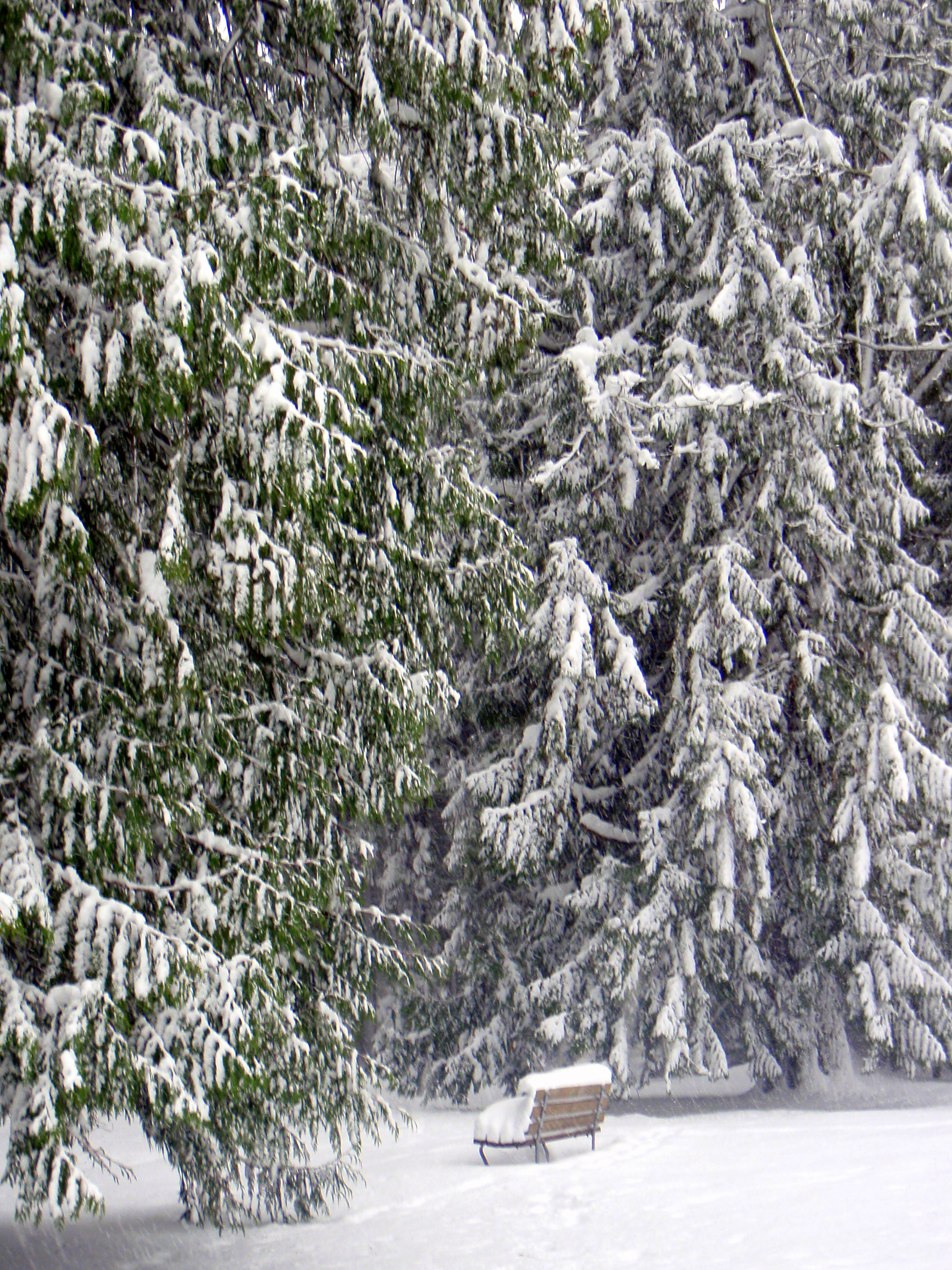
 I have noticed a lot of opinion traffic, like this, seizing on the recent cold snaps across North America and spinning it as an end to Climate Change theory. Now I am no climate change expert by any means, and I sure as hell would like the scientific consensus to be wrong (see recent Vancouver photo at right), so I dropped in on RealClimate to see what's going on.
So what to make of the latest year's data? First off, we expect that there will be oscillations in the global mean temperature. No climate model has ever shown a year-on-year increase in temperatures because of the currently expected amount of global warming. A big factor in those oscillations is ENSO – whether there is a a warm El Niño event, or a cool La Niña event makes an appreciable difference in the global mean anomalies – about 0.1 to 0.2ºC for significant events. There was a significant La Niña at the beginning of this year (and that is fully included in the D-N annual mean), and that undoubtedly played a role in this year's relative coolness. It's worth pointing out that 2000 also had a similarly sized La Niña but was notably cooler than this last year.
While ENSO is one factor in the annual variability, it is not the only one. There are both other sources of internal variability and external forcings. The other internal variations can be a little difficult to characterise (it isn't as simple as just a super-position of all the climate acronyms you ever heard of NAO+SAM+PDO+AMO+MJO etc.), but the external (natural) forcings are a little easier. The two main ones are volcanic variability and solar forcing. There have been no climatically significant volcanoes since 1991, and so that is not a factor. However, we \are at a solar minimum. The impacts of the solar cycle on the surface temperature record are somewhat disputed, but it might be as large as 0.1ºC from solar min to solar max, with a lag of a year or two. Thus for 2008, one might expect a deviation below trend (the difference between mean solar and solar min, and expecting the impact to not yet be fully felt) of up to 0.05ºC. Not a very big signal, and not one that would shift the rankings significantly.
There were a number of rather overheated claimsearlier this year that 'all the global warming had been erased' by the La Niña-related anomaly. This was always ridiculous, and now that most of that anomaly has passed, we aren't holding our breath waiting for the 'global warming is now back' headlines from the same sources.
 iBiome

Thanks for the link. My question – are these systems coming to us more frequently or severely, or is it just a function of increased awareness about forthcoming weather systems?
http://www.theweathernetwork.com/index.php?product=weathermaps&pagecontent=weathermaps&maptype=sys
To whit – I’ve always been intrigued about weather (and how earth systems work on a macro level) but its only been the past couple of years that I’ve been aware that “high pressure systems” (normally clear and sunny) rotate clockwise, and that “low pressure systems” rotate counter-clockwise.
They therefore how they impact our weather. (at the front of the systems – colder, fresher air from the north; warmer, humid, moisture-filled (in the centre and east of North America, anyway, thanks to the Gulf of Mexico. The West gets all gummed up because of the mountains, and Atlantic Canada because of Atlantic ocean effects).
The reverse, of course, happens as the arse-end of the systems pass.
Anywho, I now can understand this better due to much better weather satellite imagery. But it DOES seem that more systems are moving through, and moving through more rapidly. Or is it just me?
http://www.theweathernetwork.com/index.php?product=weathermaps&pagecontent=weathermaps&maptype=sys
(sadly, the Weather Network, which used to be more detailed, academic, and informative, had become focused on the “emotional weather” the past few years. Sad, that. They used to have a loyal viewership looking for accurate weather forecasts that made sense.) (I, for one, now get my weather from the morning Fox news Boston local broadcast – they’re weatherperson is intelligent, informative, and sexy)
LikeLike
hey buddy, nice to see you here. To answer your question – no clue. I have been wanting to educate myself about this a bit more but to really dig in takes time. I think that weather is something we are wired to pay attention to and therefore anecdotal evidence / personal experience creates a lot of noise around trying to understand climate data (for the lay person, that is). I suspect we have always had ‘crazy weather’ from time to time. Climate change, writ large, is buried in the climate data. One of the numbers to pay attention to is CO2 concentration in ppm. I can’t see how that can continue to rocket up without something very bad happening.
LikeLike